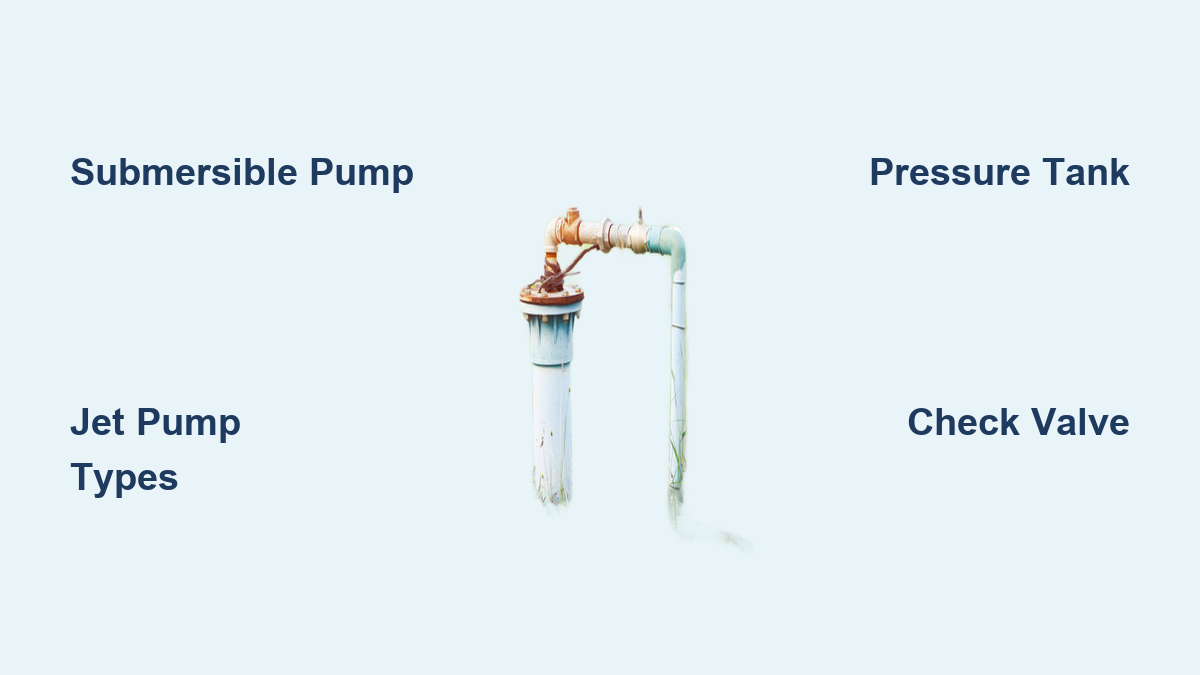
If your home relies on a private water well, you probably take clean water for granted until you turn on a faucet and it flows effortlessly. But have you ever wondered how that water travels from hundreds of feet underground into your pipes? The answer lies in the water well pump, a remarkable piece of engineering that extracts groundwater and delivers it under pressure for everyday use.
In this guide, you will learn exactly how a water well pump works, the different types available, and how each component in your system works together to provide reliable water. Whether you are troubleshooting low pressure, planning repairs, or simply curious about your home water supply, understanding these mechanics will help you maintain reliability and avoid costly failures.
Submersible Pump Operation
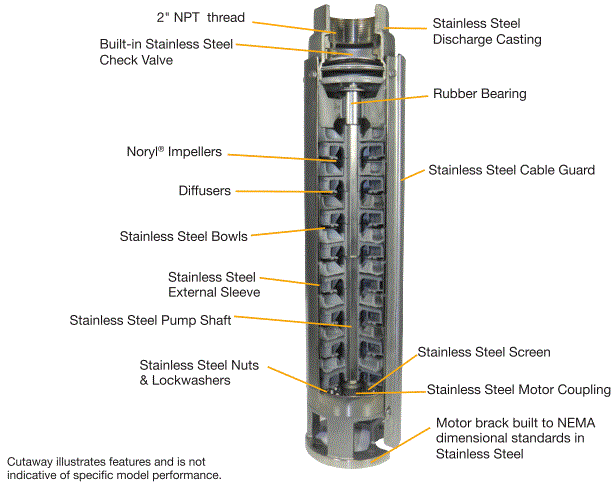
The most common residential well pump in the United States is the submersible pump, especially for wells deeper than 100 feet. This pump installs at the bottom of the well, completely submerged in water, which keeps it naturally cooled and protected from weather damage.
How Submersible Pumps Move Water
Water enters the pump through a bottom intake screen designed to block large debris while allowing free flow. Inside, a sealed electric motor spins a series of impellers. These rotating discs use centrifugal force to fling water outward. Each impeller feeds into a diffuser, which slows the water velocity and converts kinetic energy into pressure.
This multistage process repeats across several stages, progressively boosting pressure until the water can be pushed up the drop pipe. A typical three-quarter-horsepower submersible pump delivers about 10 gallons per minute at 50 to 60 psi, which handles standard household demands like showers, dishwashers, and laundry.
Why Submersible Pumps Dominate Deep Wells
Submersible pumps are efficient, quiet, and self-priming, meaning you never need to fill the system with water before starting. Because they push water rather than suck it, they are not limited by atmospheric pressure, making them ideal for deep wells. However, repairs require pulling the entire unit from the well, which often needs professional equipment and expertise.
Jet Pump Function Explained
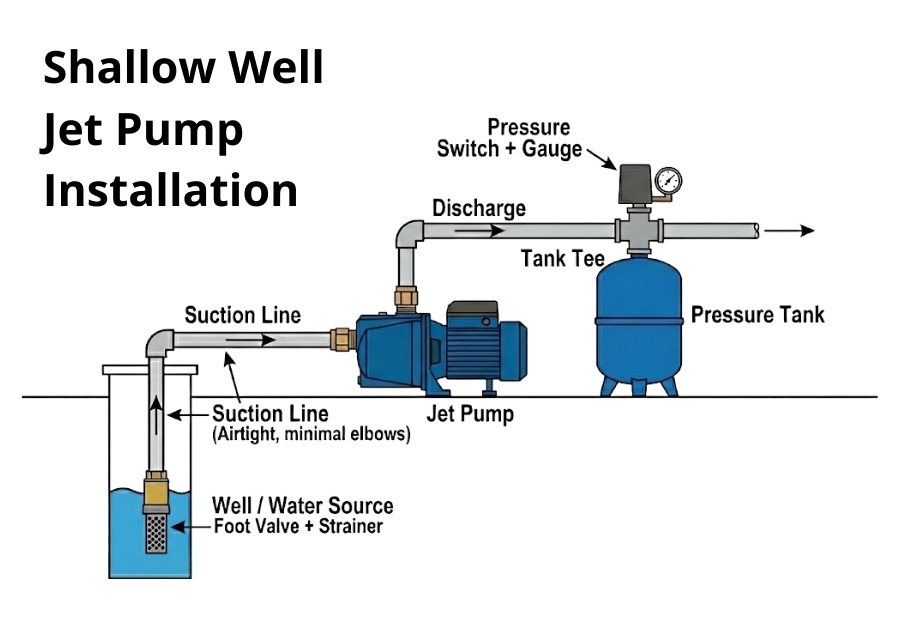
For shallower or mid-depth wells, jet pumps offer an above-ground alternative. These pumps come in two forms: shallow well and deep well, each using the Venturi effect to create suction and move water.
Shallow Well Jet Pump Mechanics
Used in wells less than 25 feet deep, these pumps rely on atmospheric pressure to push water up a single pipe. An impeller inside the pump sends drive water through a narrow jet, creating high velocity and a low-pressure zone. This vacuum pulls well water up through the same pipe. A check valve prevents backflow when the pump stops.
Because atmospheric pressure limits suction lift to about 25 feet in practice, shallow jet pumps are unsuitable for deeper installations. They also require manual priming, meaning you must fill the pump and pipes with water before first use, since they cannot pump air effectively.
Deep Well Jet Pump Design
For wells between 25 and 110 feet, double-drop jet pumps use two pipes. One carries pressurized drive water down to a submerged jet assembly. The second returns the combined flow up to the surface. The submerged jet creates a vacuum that draws in standing water, mixing it with the drive stream.
This design bypasses the atmospheric lift limit by creating suction below the water table. Some models include a 35-foot tailpipe to keep the jet submerged even during low water levels. While more versatile than shallow jet systems, they are still less efficient than submersible pumps and require regular priming and maintenance.
Centrifugal Pump Use Cases
Centrifugal pumps are simple, above-ground units that use a spinning impeller to generate flow. Limited to very shallow depths under 25 feet, they are often used in temporary setups, irrigation, or low-cost installations.
These pumps work by accelerating water radially outward from the center of the impeller, then directing it into a volute casing where velocity converts to pressure. However, without a priming mechanism or secondary jet system, they cannot overcome significant vertical lift.
They are rarely used in permanent domestic well systems due to their inefficiency and depth limitations, but they remain useful in specific scenarios like dewatering or surface water transfer.
Drop Pipe and Water Delivery Path
Once water is lifted by the pump, it travels to the surface through the drop pipe, a rigid conduit made of PVC or steel that connects the pump to the wellhead.
Role of the Drop Pipe
This pipe must withstand internal pressure, support the weight of the submerged pump, and resist corrosion. In deep wells, multiple sections join with threaded couplings. For submersible systems, the drop pipe also houses the power cable running down to the motor, often strapped directly to the outside.
Damage to the drop pipe, such as cracks, leaks, or loose connections, can lead to loss of prime, reduced flow, or complete system failure. Regular inspection during pump servicing helps prevent such issues.
Exit Via Pitless Adapter
At the frost line, water exits the well horizontally through a pitless adapter, a freeze-proof fitting that allows the water line to run underground to the house. This eliminates the need for a heated pump house and protects against freezing in cold climates.
The pitless adapter also enables pump removal for servicing without disturbing the home-side plumbing. It seals tightly when reinstalled, maintaining system integrity and contamination protection.
Pressure Tank Function and Types
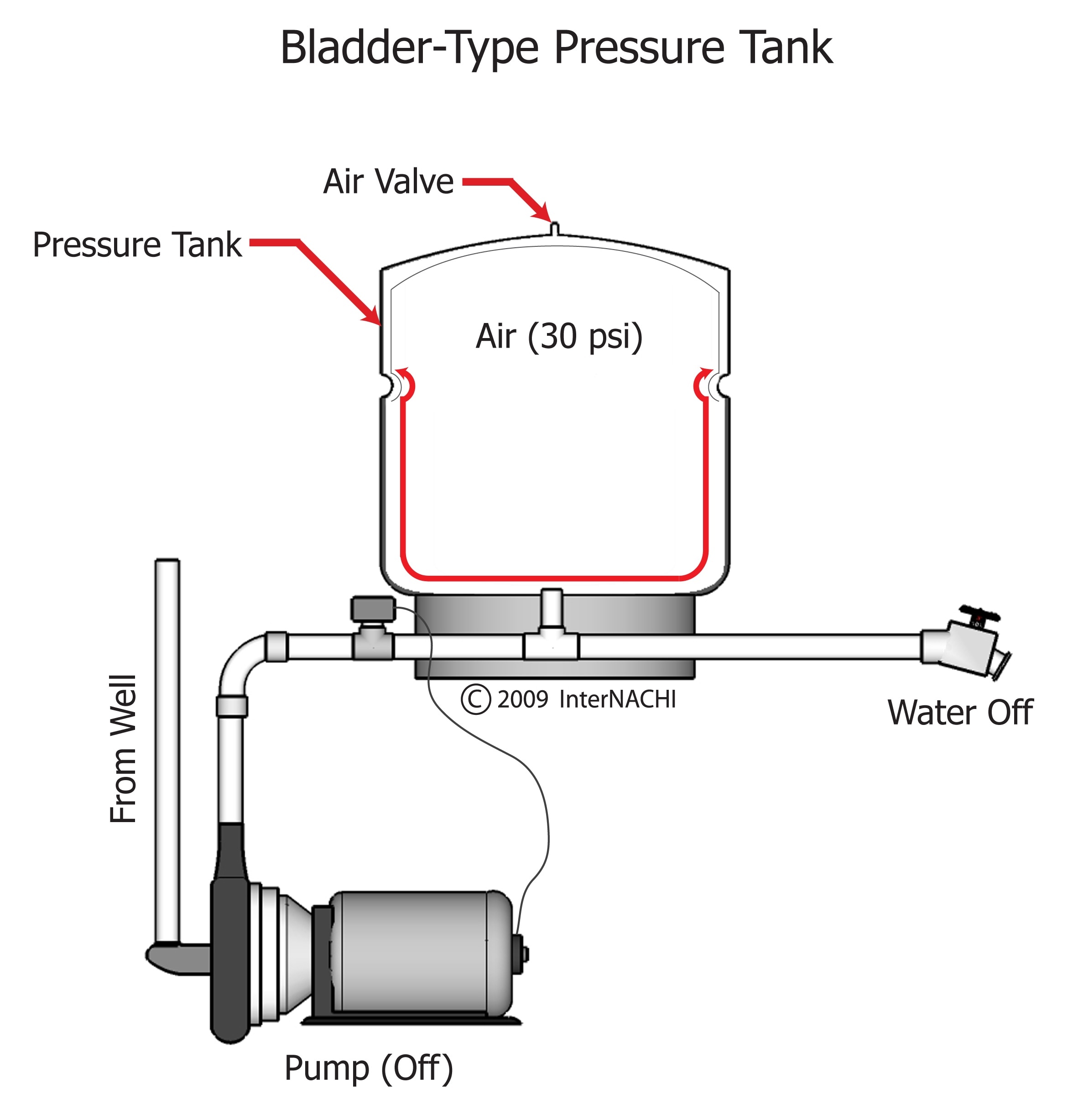
Without a pressure tank, your well pump would cycle on and off every time a faucet opened, even briefly. This frequent cycling causes overheating, wear, and premature failure. The pressure tank prevents this by storing pressurized water and acting as a buffer.
Bladder vs. Older Tank Designs
Modern systems use bladder or diaphragm tanks, where a rubber membrane separates air from water. When the pump runs, water compresses the air inside the bladder, building pressure. As water is used, the compressed air pushes it through the plumbing.
Older systems may have air-over-water galvanized steel tanks, where air sits atop the water. These are prone to waterlogging, a condition where air dissolves into the water, eliminating the cushion effect and causing short cycling.
Sizing and Pre-Charging
Tanks range from 20 to 60 gallons in residential applications. Larger tanks reduce pump cycles, extending motor life. For a 40 to 60 psi system, the tank should be pre-charged to 38 psi when empty, which is 2 psi below the cut-in pressure. This ensures proper operation and prevents bladder stress.
Pressure Switch Control Logic
The pressure switch is the brain of the system, monitoring line pressure and turning the pump on or off based on preset thresholds.
How the Switch Triggers Pump Cycles
When pressure drops to the cut-in point, such as 40 psi, the switch closes the electrical circuit, powering the pump. Once pressure reaches the cut-out point, such as 60 psi, the switch opens, stopping the pump. Standard settings are 40 to 60 psi, though some systems use 30 to 50 psi for older pumps or lower-pressure needs.
Adjustable switches allow customization, but incorrect settings can cause short cycling or over-pressurization.
Maintenance and Replacement
Pressure switches wear out over time. Signs of failure include the pump not starting, the pump running continuously, or erratic pressure fluctuations. Replacement is recommended every 5 to 7 years or at the first sign of malfunction. A new switch typically costs $16 to $25, far less than replacing a burned-out motor.
Check Valve Purpose and Placement
A check valve ensures water flows only upward, never back into the well. Installed on the drop pipe or near the wellhead, it maintains system prime and pressure when the pump shuts off.
Why Multiple Valves Are Used
In deep wells over 200 feet, check valves place every 100 to 200 feet to prevent excessive backflow. Without them, water column weight could force water down, requiring the pump to re-prime with each cycle.
In submersible pumps, the check valve includes a rubber seal, plastic disc, and spring-loaded cap. When the pump runs, upward pressure lifts the seal. When it stops, backpressure forces it shut.
Failure Consequences
A failed check valve leads to short cycling, loss of pressure, increased energy use, and premature motor burnout. Regular inspection during servicing helps catch issues early.
Water Flow Sequence Simplified
Understanding the full journey of water from aquifer to faucet reveals how each component contributes to reliable delivery.
Step-by-Step Water Movement
The process begins when pressure drops from opening a faucet, triggering the pressure switch. The submersible or jet pump then draws water from the aquifer. Water travels up through the drop pipe and exits through the pitless adapter. It flows into the home, passing through a check valve and into the pressure tank. As the tank fills, water compresses the air bladder. When fixtures are used, stored water pushes through plumbing under pressure. Once pressure drops again, the switch restarts the pump.
This cycle repeats seamlessly, usually without homeowner awareness, unless something fails.
Integration with Water Treatment
Many homes add water softeners or conditioners to address hard water, iron, or odor issues. But placement matters significantly.
Correct Installation Sequence
Treatment systems must install after the pressure tank, never before. Placing a softener upstream creates backpressure that interferes with pump operation and can cause damage. A water softener removes calcium and magnesium using salt-based ion exchange. A conditioner treats high iron or manganese, preventing rust stains and metallic taste.
Both require periodic maintenance, but they ensure better water quality and protect appliances.
Sizing Pump and Tank Correctly
An improperly sized system leads to poor performance, frequent cycling, or early failure.
Matching Pump to Demand
Household water needs are measured in gallons per minute. A typical two-bathroom home with 12 fixtures requires 8 to 12 gpm during peak use. Undersized pumps cannot meet demand and may overheat. Oversized pumps waste energy and cause pressure surges.
Proper sizing depends on well depth, static water level, fixture count, and irrigation needs.
Choosing the Right Tank Size
Larger tanks reduce pump cycles. For homes with low well yield, a bigger tank acts as a buffer during high demand. The minimum recommendation is one day water supply for emergency backup, which is optional but practical.
Maintenance Schedule and Tasks
Regular upkeep prevents small issues from becoming major failures.
Annual and Routine Checks
Professional inspection should occur annually. Quarterly tasks include checking the well cap seal and inspecting for damage. Every 3 to 6 months, flush the tank drain valve. Annually, test the pressure relief valve, clean the vent screen, and inspect the pressure switch.
A yearly professional tune-up checks electrical connections, tank air charge, pump performance, and water quality, helping extend system life.
Troubleshooting Common Problems
When water pressure drops or the pump acts strangely, these common issues may be the cause.
Low Pressure Causes
Low pressure typically stems from a failed pressure switch, waterlogged pressure tank, clogged filter or check valve, or leaky plumbing. The fix involves testing switch functionality, checking tank air charge, and inspecting filters.
Pump Short Cycling
Frequent on/off cycling usually means a failed bladder in the pressure tank. The system loses its air cushion, causing rapid pressure drops. Solution involves recharging the tank with an air compressor or replacing the bladder.
Pump Will Not Start
Possible reasons include a tripped circuit breaker, power outage, failed pressure switch, lost prime for jet pumps, or motor burnout. Fix by resetting the breaker, testing the switch, re-priming the jet pump, or calling a technician.
Constant Pump Operation
If the pump runs nonstop, look for a system leak, failed check valve, or loss of tank pressure. Fix by inspecting for wet spots, replacing the check valve, and checking tank charge.
Safety Rules and Best Practices
Ignoring safety can lead to equipment damage, contamination, or injury.
Critical Safety Points
Never remove the pressure relief valve, which opens at 75 psi to prevent tank explosion. Keep the well cap sealed to prevent insects, animals, and pathogens from entering. Avoid backpressure from treatment units by installing water softeners or filters after the pressure tank. Ensure electrical safety with proper grounding and surge protection.
Lifespan and Failure Signs
With proper care, well pumps last for years, but eventually fail.
Expected Service Life
Jet pumps typically last 8 to 15 years. Submersible pumps last 20 to 25 years. Longevity depends on water quality, cycle frequency, electrical stability, and proper sizing.
Early Warning Signs
Watch for fluctuating pressure, strange noises like grinding or banging, longer run times, and frequent cycling. These often signal worn impellers, failing bearings, or electrical issues.
Pump Selection Guide by Depth
Choosing the right pump depends on your well characteristics.
Matching Pump to Well Depth
For shallow wells under 25 feet, the best choice is a single-drop jet pump or centrifugal pump. These work because atmospheric pressure supports suction lift, and easy access simplifies maintenance.
For moderate depth between 25 and 100 feet, the best choice is a double-drop jet pump or shallow submersible. Jet pumps use downhole suction, while submersibles offer better efficiency.
For deep wells over 100 feet, the best choice is a multistage submersible pump. Only submersibles can efficiently push water from extreme depths. Consider water quality and household demand when finalizing your selection.
Frequently Asked Questions About Water Well Pumps
How does a submersible pump push water from deep wells?
Submersible pumps use multiple impeller stages to push water upward. Each impeller accelerates water using centrifugal force, then a diffuser converts that velocity into pressure. The process repeats across several stages, progressively increasing pressure until water reaches the surface.
What causes a well pump to cycle on and off frequently?
Short cycling usually indicates a waterlogged pressure tank, where the air bladder has failed. This eliminates the cushion effect, causing rapid pressure drops. Replace the bladder or the entire tank to resolve this issue.
Can I install a water softener before my pressure tank?
No, water softeners must install after the pressure tank. Installing treatment systems upstream creates backpressure that interferes with pump operation and can cause damage over time.
How long does a well pump typically last?
Jet pumps last 8 to 15 years, while submersible pumps last 20 to 25 years with proper maintenance. Lifespan depends heavily on water quality, especially sand content, and how often the pump cycles.
What is the difference between a jet pump and a submersible pump?
Jet pumps use suction to draw water and install above ground, making them easier to service but limited to shallow depths. Submersible pumps push water from below and install deep in the well, offering better efficiency for deep wells but requiring professional removal for repairs.
Why does my well pump keep running even when I am not using water?
This usually indicates a leak in the system, a failed check valve, or loss of air pressure in the pressure tank. Inspect all plumbing for leaks, test the check valve operation, and check the tank air charge to identify the cause.
Key Takeaways for Understanding Your Water Well Pump
A water well pump system is a self-sustaining network designed to deliver clean, pressurized water on demand. The submersible pump, the most common choice for deep wells, uses multistage impellers to push water upward efficiently. The pressure tank acts as a buffer, preventing constant pump cycling and maintaining steady pressure throughout your home.
Understanding how each component works together empowers you to troubleshoot issues confidently, maintain your system properly, and extend equipment life. Regular maintenance, proper installation of treatment systems, and adherence to safety practices keep the system running smoothly for decades. Whether you are managing a shallow jet setup or a deep submersible system, knowing the mechanics behind your water flow leads to smarter decisions and fewer surprises.