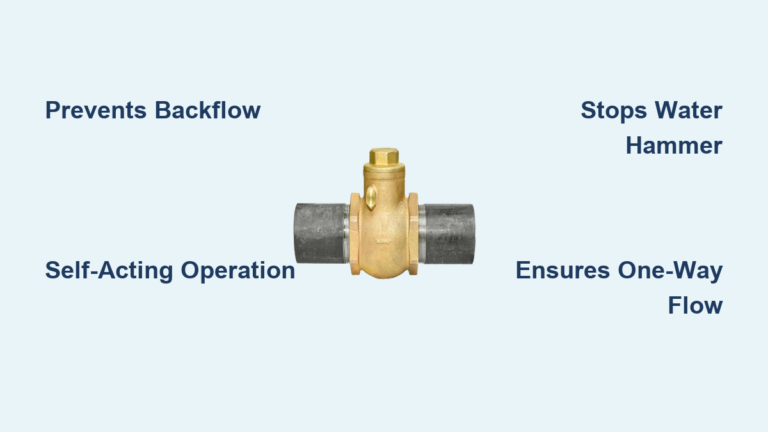
You shut down a pump, expecting silence, but instead hear a metallic groan as fluid surges backward through your pipes. Left unchecked, this backflow can destroy seals, erode fittings, and ruin expensive equipment within minutes. The simple solution is a check valve, a self-acting device that allows flow in only one direction and blocks reverse movement entirely.
Understanding check valve function is essential for anyone working with plumbing, hydraulics, HVAC, or industrial process systems. These valves operate without electricity, handles, or operator input, relying solely on pressure differentials to open and close. In this guide, you will learn how check valves work, the different types available, their key applications, and how to select, maintain, and troubleshoot them effectively.
How Check Valves Work Automatically

Check valves rely on fluid dynamics and internal force balance to function. They require no external power or operator input, only a change in pressure to respond.
Cracking Pressure and Flow Initiation
The cracking pressure is the minimum upstream pressure needed to lift the disc, ball, or poppet off its seat and allow flow. This value varies by design and application, ranging from less than 1 psi in low-pressure systems to over 350 psi in high-pressure industrial lines. If inlet pressure fails to meet cracking pressure, the valve stays closed due to spring force, gravity, or system backpressure.
Once cracking pressure is reached, the closing element moves and creates a flow path. As pressure increases further, the valve opens wider until reaching its fully open position, allowing maximum flow with minimal resistance.
The Eight-Stage Operation Cycle
Rather than a simple on/off switch, spring-loaded check valves follow a dynamic eight-stage cycle:
- Shut – Valve is closed; spring or gravity holds the disc seated.
- Opening – Inlet pressure overcomes spring force; disc begins to lift.
- Open – Flow starts; disc stabilizes based on pressure balance.
- Fully Open – Maximum lift achieved; flow unrestricted.
- Descent – Inlet pressure drops; spring starts pushing disc down.
- Touch Down – Disc nears seat; minimal flow remains.
- Resealing – Disc fully seats; forward flow stops.
- Reset – Spring returns to preload; valve ready for next cycle.
This precise sequence ensures reliable, repeatable performance while minimizing wear and water hammer.
Key Applications Across Industries
.jpg)
Check valves serve vital roles in diverse systems where unidirectional flow is non-negotiable.
Protect Pumps from Backspin
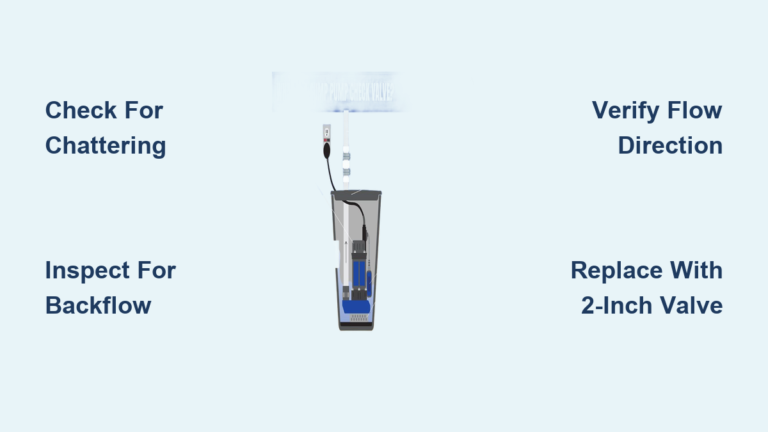
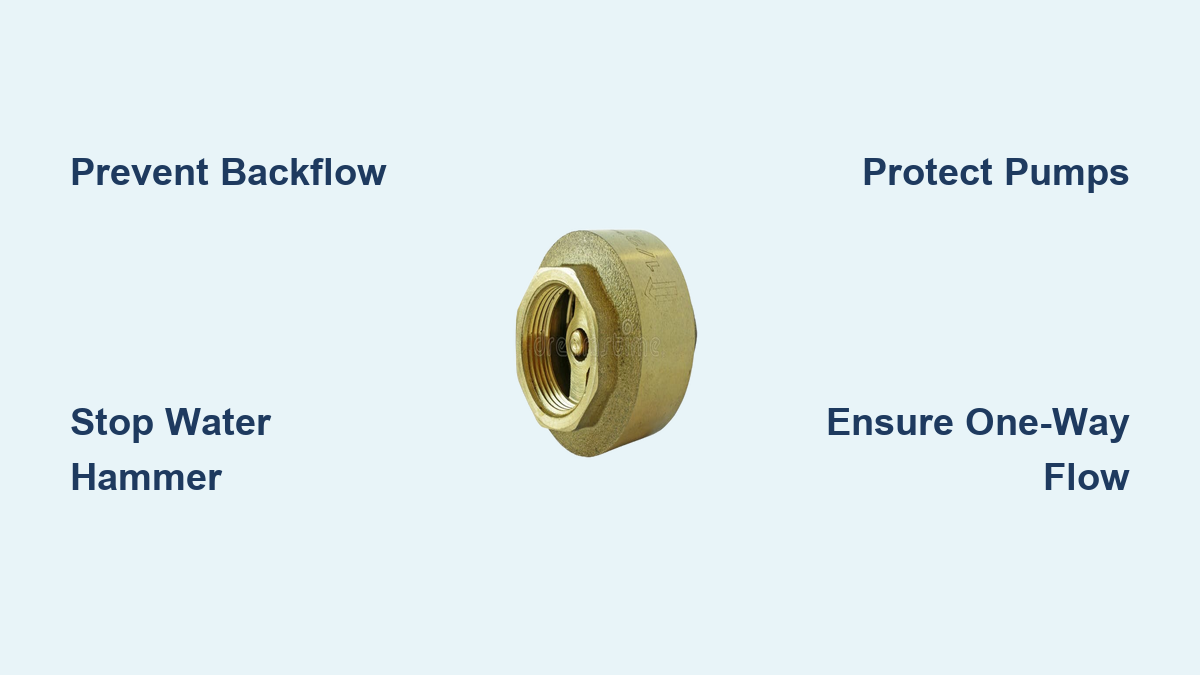
When a pump shuts off, discharge pressure can force fluid backward, causing the impeller to spin in reverse, a phenomenon known as backspin. This can overheat motors, damage bearings, and destroy seals. A check valve installed on the discharge line prevents this by closing immediately when flow stops, maintaining prime and protecting equipment.
In multi-pump setups, whether parallel or series, check valves isolate active units from idle ones, preventing recirculation and energy waste.
Prevent Contamination in Sensitive Systems
In food, pharmaceutical, and water treatment applications, cross-contamination is unacceptable. Check valves ensure treated water does not flow back into raw supply lines. They are integral to Clean-in-Place (CIP) and Sterilize-in-Place (SIP) systems, maintaining hygiene and regulatory compliance.
Similarly, in fuel systems, they prevent gasoline from draining back into tanks, ensuring quick engine restarts and avoiding vapor lock.
Stop Water Hammer Damage
Water hammer occurs when fluid flow stops suddenly, creating a shockwave that can rupture pipes and damage fittings. Standard swing check valves that slam shut during backflow are often culprits.
To prevent this, silent check valves, tilting disc valves, or those with dashpots close gently or act before reversal begins. These designs absorb momentum and eliminate pressure surges, making them ideal for high-velocity water systems like fire protection and hydronic heating.
Enable Venting and Draining
Some check valves serve dual functions. Vent check valves allow air to escape from sealed systems like fuel tanks to prevent over-pressurization while blocking moisture and debris.
Fill and drain valves let operators charge hydraulic systems with fluid, then manually open them to safely depressurize and drain during maintenance.
Types of Check Valves and Their Uses
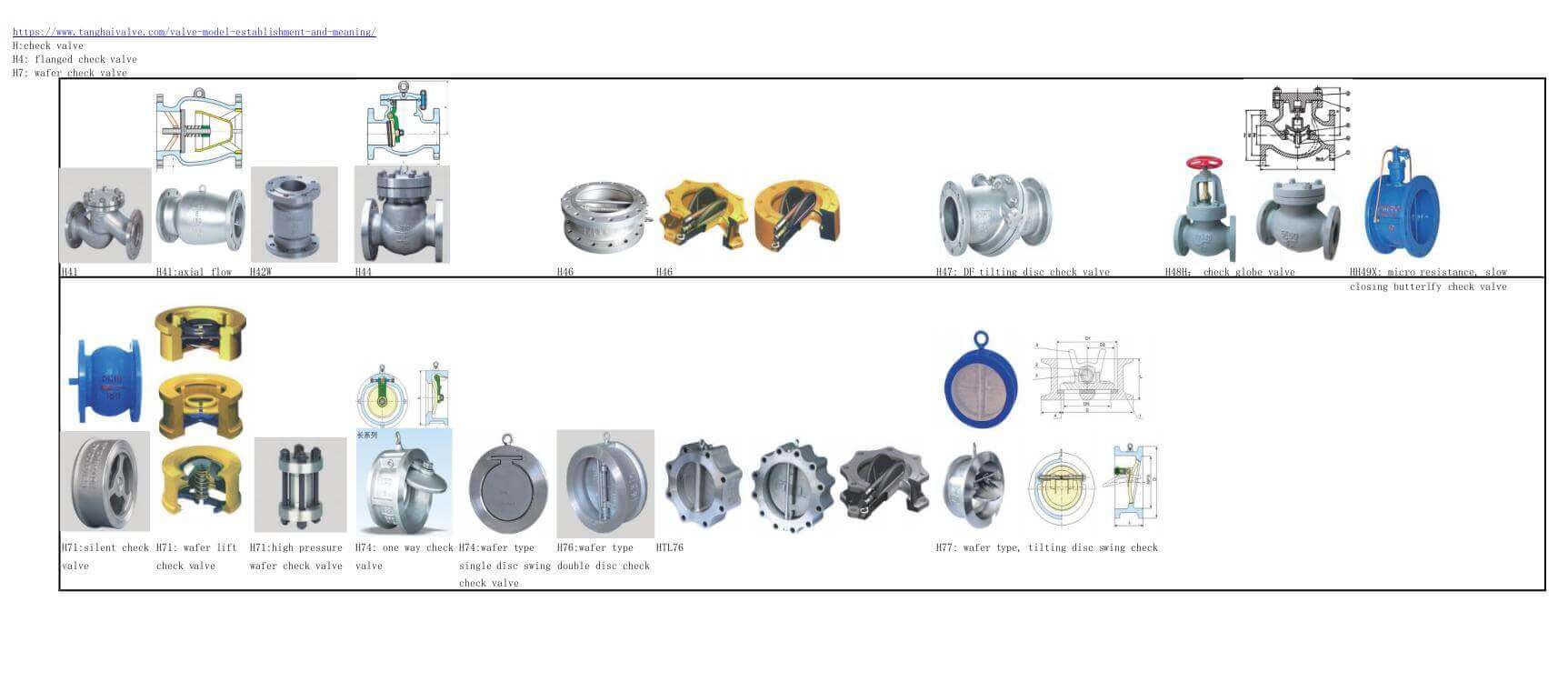
Each type of check valve offers unique advantages depending on flow conditions, space constraints, and media type.
Swing Check Valves
A hinged disc swings open with forward flow and closes via gravity or backflow.
- Best for: Large-diameter, low-velocity water and oil lines
- Pros: Low pressure drop, full port design
- Cons: Slow closure may cause water hammer; not ideal for vertical lines unless spring-assisted
Variants include lever and weight designs for controlling closing speed, spring-assisted models for faster closure in high-pressure lines, and dashpot-equipped versions that dampen closure to prevent slamming.
Wafer Check Valves
Slim, lightweight valves sandwiched between flanges.
- Best for: Tight spaces, wastewater, slurry
- Pros: Compact, fast-closing, cost-effective
- Cons: Limited repairability; requires flange removal for servicing
Common in dual-disc configurations for rapid response.
Tilting Disc Check Valves
Disc pivots near center, allowing smooth flow over and under.
- Best for: High-velocity water, power plants, petrochemical
- Pros: Reduced water hammer, stable under fluctuating flow
- Cons: Higher initial cost
Ideal where flow changes rapidly and noise control is critical.
Ball Check Valves
A spherical ball lifts off a conical seat with forward pressure.
- Best for: Vertical lines, sewage, slurry
- Pros: Self-guiding, resistant to solids, low maintenance
- Cons: Can be noisy; not for high-precision sealing
Widely used in chemical dosing and wastewater treatment.
Lift Check Valves
Guided piston or disc moves vertically, usually requiring vertical installation.
- Best for: High-pressure steam, boiler feedwater
- Pros: Tight shut-off, excellent for pump protection
- Cons: Must be installed vertically; higher pressure drop
Also called piston check valves, these are common in oil and gas transmission.
Silent Check Valves
Spring-loaded poppet closes rapidly before reverse flow begins.
- Best for: Potable water, HVAC, hydronic systems
- Pros: Eliminates water hammer, quiet operation
- Cons: Slightly higher cracking pressure
Essential in buildings where noise and pipe integrity matter.
Butterfly Check Valves
Two hinged half-discs fold open with flow and snap shut on reversal.
- Best for: Fire protection, HVAC, large water lines
- Pros: Very fast closure, wafer-thin profile
- Cons: Limited to lower pressures
Popular due to compact size and reliability.
Duckbill Check Valves
Flexible rubber sleeve shaped like a duck’s beak.
- Best for: Stormwater, sewage, corrosive media
- Pros: No moving parts, self-cleaning, clog-resistant
- Cons: Limited pressure and temperature range
Used in environmental outfalls and marine applications.
Diaphragm Check Valves
Flexible rubber diaphragm flexes open with pressure.
- Best for: Food, pharma, ultra-clean systems
- Pros: Quiet, leak-free, resists clogging
- Cons: Not for high-pressure use
Ideal for aggressive chemicals and sterile processes.
Foot Check Valves
Installed at pump intakes with built-in strainer.
- Best for: Well pumps, irrigation, firefighting
- Pros: Maintains prime, filters debris
- Cons: Must be vertical; requires regular cleaning
Critical for submersible and centrifugal pumps.
Pneumatic Check Valves
Designed for air and gas circuits.
- Best for: Automation, air tools, process controls
- Pros: Maintains pressure in pneumatic lines
- Cons: Limited to gaseous media
Ensures tools stay pressurized when not in use.
Selecting the Right Check Valve
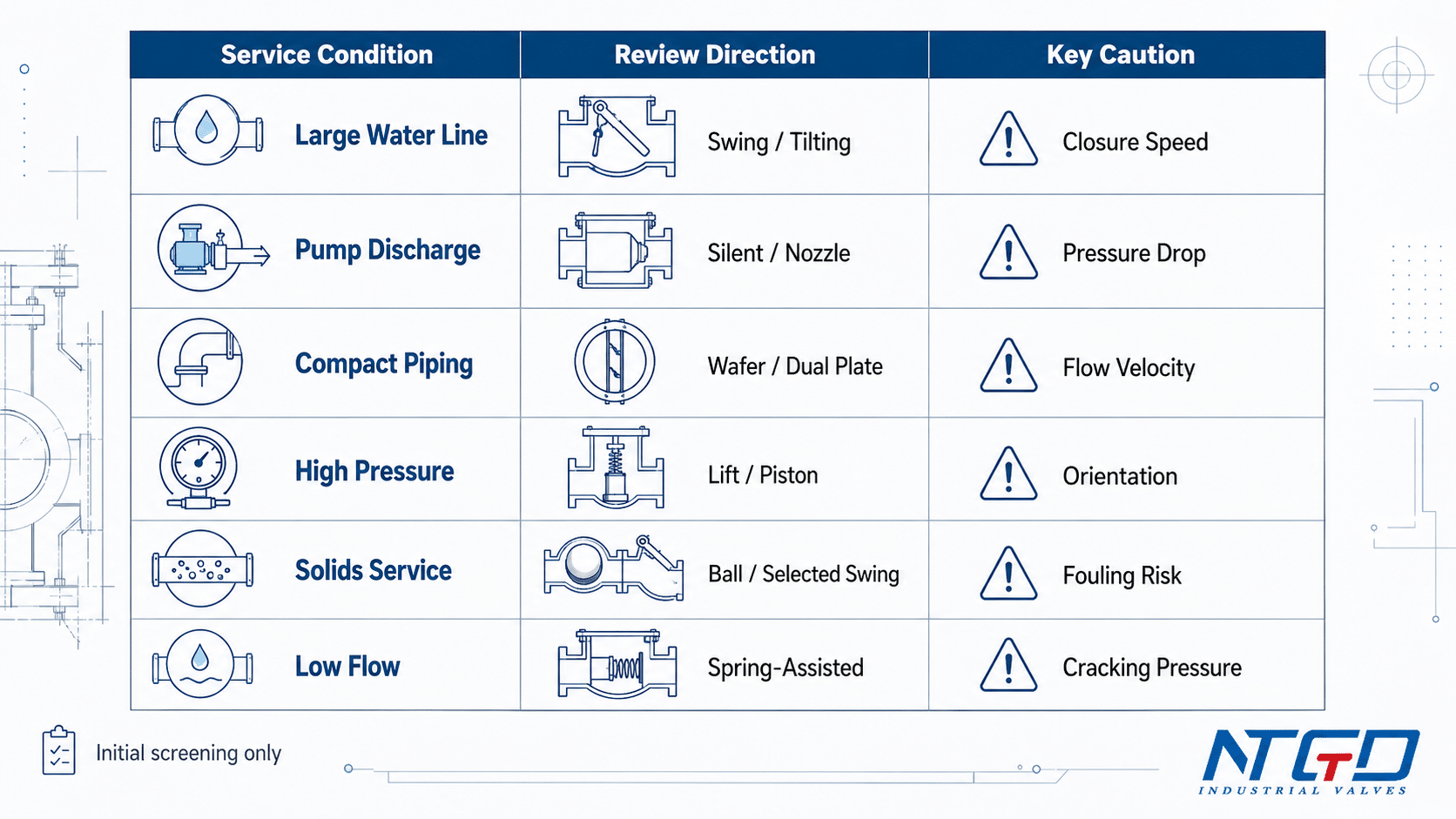
Choosing the correct valve prevents failure, reduces maintenance, and improves efficiency.
Match Media and Material
Material compatibility determines durability and seal integrity. Use bronze, ductile iron, or stainless steel for water and steam. For seawater, select bronze or 316 stainless steel. For chemicals, choose PVC, CPVC, PVDF, or polypropylene. For slurries, use ball, duckbill, or wafer designs. For high-pressure gas, opt for cast steel or stainless steel.
Seals matter too: Use EPDM for water and Viton for oils and fuels.
Consider Flow and Velocity
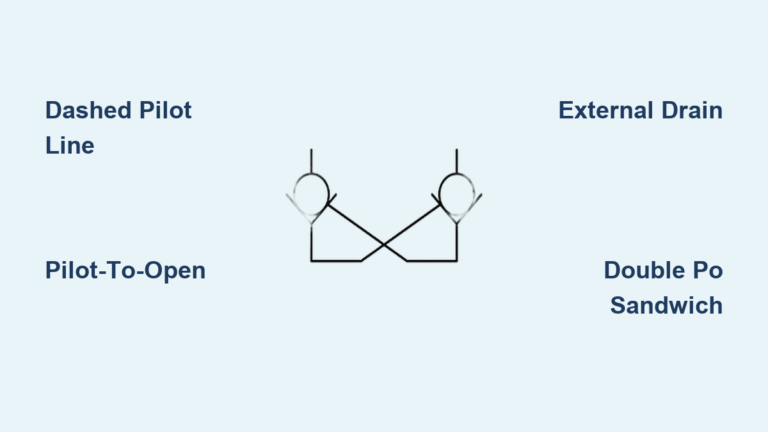
Low velocity systems (below 6 ft/sec) work well with swing or lift check valves. High velocity systems (above 12 ft/sec) require tilting disc or silent check valves. Pulsating flow systems should avoid standard swing checks and instead use spring-assisted or pilot-operated designs.
Undersized valves increase pressure drop while oversized ones cause chattering.
Evaluate Cracking Pressure Needs
Low-flow systems need low cracking pressure (below 1 psi). High-pressure systems require higher cracking pressure (up to 350 psi). Vertical lines need spring-loaded valves to overcome gravity.
Too high a cracking pressure prevents opening while too low risks leakage.
Install in Correct Orientation
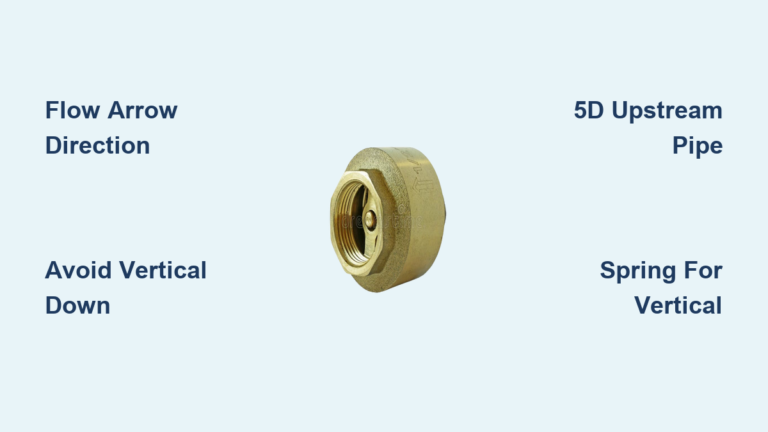
Most swing and wafer valves work horizontally. Lift, foot, and spring-loaded valves require vertical installation with upward flow. Spring-assisted designs can operate in any position.
Never install gravity-dependent valves upside down.
Prevent Water Hammer
If your system has long pipe runs or sudden shutdowns, choose silent check valves, tilting disc valves, or swing checks with dashpots. Avoid standard swing checks in high-surge risk zones.
Common Problems and Fixes
Even robust valves fail if misapplied or neglected.
Water Hammer: Loud Bangs and Pipe Stress
Cause: Disc slams shut during backflow.
Fix: Replace with silent, tilting disc, or dashpot-equipped valve. Ensure proper sizing.
Reverse Flow and Backspin
Cause: Slow-closing valve or worn seal.
Fix: Install fast-acting spring-assisted valve. Inspect seating surface for damage.
Chattering (Rapid Opening and Closing)
Cause: Oversized valve in low-flow application.
Fix: Reselect valve for minimum expected flow. Use low-cracking-pressure models.
Sticking or Fouling
Cause: Debris, scale, or corrosion jams disc.
Fix: Install strainers upstream. Use ball or duckbill valves for dirty media. Clean foot valves regularly.
Installation Errors
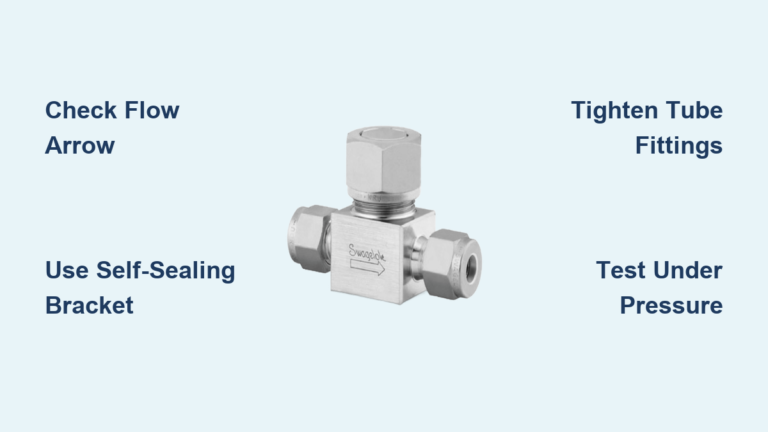
Installing a valve too close to a pump causes turbulence. Provide 5 to 10 pipe diameters of straight run before and after the valve.
Installing a gravity check in a vertical line prevents closure. Use a spring-assisted or lift check valve instead.
Advantages and Limitations
Benefits of Check Valves
Check valves offer automatic operation with no power or operator needed. They shield pumps, compressors, and motors from damage. They keep media isolated to prevent contamination. Proper designs reduce water hammer. With few moving parts, they require low maintenance. Compact designs like wafer and butterfly types save space. They provide passive safety that remains active even during power loss.
Drawbacks to Consider
Check valves cannot regulate flow manually. Without instrumentation, it is hard to tell if they are open or closed. Wrong type selection creates slamming risk. Standard valves may chatter in pulsating flow. Internal inspection requires disassembly.
Testing and Maintenance Tips
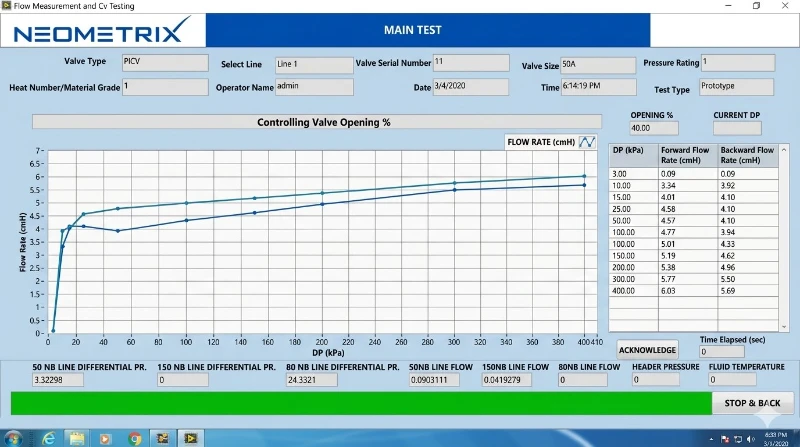
Regular checks extend valve life and prevent failure.
Key Tests
A cracking pressure test gradually increases pressure until first flow appears, confirming against spec. A leakage test applies reverse pressure and checks for bubbles or drip rate per API 598 or ISO 5208. A flow coefficient (Cv) test measures pressure drop at various flows to assess efficiency. A cycle life test simulates repeated operation to verify durability.
Maintenance Best Practices
Inspect monthly for leaks, corrosion, vibration, or noise. Clean strainers, especially on foot valves in dirty systems. Lubricate hinges on swing check valves to prevent seizing. Replace seats and discs if pitted, scored, or leaking. Check springs for fatigue or corrosion in critical applications.
Frequently Asked Questions About Check Valve Function
What is the main purpose of a check valve?
The main purpose of a check valve is to allow fluid or gas to flow in one direction only while preventing reverse flow. This protects pumps, prevents contamination, and reduces water hammer in plumbing, hydraulic, and industrial systems.
How does cracking pressure affect check valve function?
Cracking pressure is the minimum upstream pressure required to open the valve. If inlet pressure does not reach this threshold, the valve stays closed. Cracking pressure ranges from below 1 psi in low-flow systems to 350 psi in high-pressure industrial applications.
What causes water hammer in check valves?
Water hammer occurs when a standard swing check valve slams shut during flow reversal, creating a destructive pressure surge. Silent check valves, tilting disc valves, or dashpot-equipped designs prevent this by closing gently or before reversal begins.
Can check valves be installed vertically?
Some check valves can be installed vertically, but it depends on the type. Lift, foot, and spring-assisted valves work vertically. Standard swing check valves rely on gravity and may fail to close in vertical lines unless spring-assisted.
How often should check valves be inspected?
Check valves should be inspected monthly for leaks, corrosion, vibration, or noise. Foot valves in dirty systems need more frequent cleaning. Seats, discs, and springs should be replaced when worn or fatigued.
What is the difference between a check valve and a non-return valve?
These terms are often used interchangeably, but technically a non-return valve operates in binary states (fully open or fully closed). A check valve can offer a range of flow rates depending on inlet pressure, providing flow regulation alongside backflow prevention.
Key Takeaways for Mastering Check Valve Function
The check valve function is deceptively simple: allow flow one way and block it the other. Yet its impact on system safety, efficiency, and longevity is profound. From protecting a small pump to ensuring clean drinking water, the right check valve makes all the difference.
Start by identifying your media type, flow velocity, and installation orientation. Match these parameters to the appropriate valve design, whether swing, silent, tilting disc, or specialty type. Then establish a routine inspection schedule to catch wear before it becomes failure.
Your next step: Audit your current systems for backflow risks and check valve placement. Replace any standard swing checks in high-velocity lines with silent or tilting disc designs to eliminate water hammer and protect your equipment for years to come.