If you’ve ever pulled up water from a well using a hand-operated pump, you’ve participated in one of humanity’s oldest and most reliable methods of accessing clean groundwater. But how does a hand water pump work? At first glance, it may seem like simple elbow grease is all it takes, but behind that rhythmic up-and-down motion lies a clever system of valves, pressure differentials, and mechanical advantage. Understanding this process is essential for anyone relying on manual water access in rural homes, off-grid homesteads, or emergency preparedness setups.
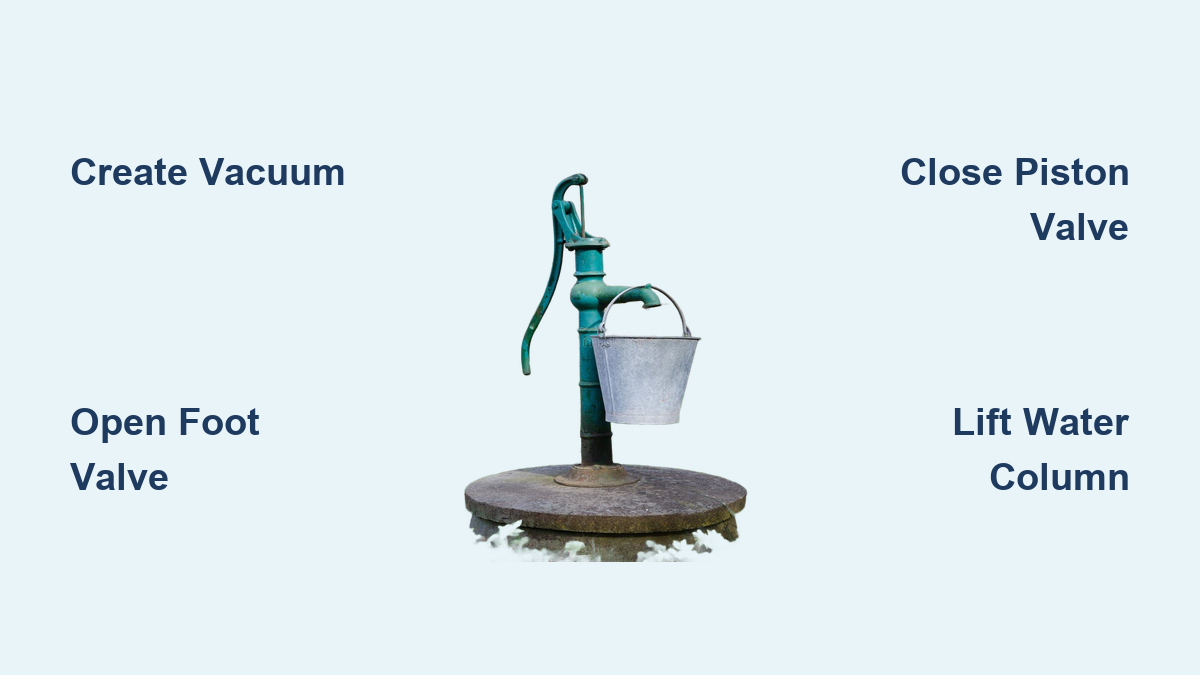
A hand water pump operates on positive displacement, using human-powered reciprocating motion to lift water from underground aquifers. It relies on two key principles: atmospheric pressure and one-way check valves. When you raise the handle, a vacuum forms below the piston, drawing water upward. When you push down, that water is sealed and pushed further toward the surface. This guide breaks down exactly how each component contributes, explains the pumping cycle in plain terms, and helps you choose the right pump for your needs.
Core Components That Make Pumping Possible

Every hand water pump functions as a mechanical system powered entirely by human effort. Its reliability comes from a few well-designed parts working in harmony. Understanding these components is the first step to understanding how the entire system works.
Handle and Pump Rod Mechanism
The handle is your point of control. When you move it up and down, it acts as a lever, multiplying your force to reduce strain. This motion transfers through the pump rod, a long rigid shaft that extends deep into the well. In shallow pumps, the rod connects directly to a piston above ground. In deep-well models, it travels dozens or even hundreds of feet underground to reach the submerged cylinder. The rod must remain straight and well-lubricated to minimize friction and prevent wear.
Piston and Dual Valve System
At the heart of the pump is the piston, a movable plug inside the cylinder equipped with seals, typically made of synthetic rubber today, to create a watertight fit. Attached to the piston is the piston valve, a one-way check valve that opens only when pressure builds below it. This valve ensures water moves upward and never slips back down during the upstroke.
Below the piston sits the foot valve, also a non-return valve at the base of the cylinder. It opens during the upstroke to let water into the lower chamber and snaps shut during the downstroke to prevent backflow into the aquifer. Together, these two valves create a one-directional flow path where water can only go up.
Cylinder and Riser Pipe Setup
The cylinder is the sealed chamber housing the piston. In lift pumps, it is installed below the water table, submerged in groundwater. Two main designs exist. The closed-top cylinder, seen in models like India Mark II, is smaller than the riser pipe and requires full disassembly for repairs. The open-top cylinder, seen in models like Afridev and India Mark III, matches the riser diameter, allowing internal parts to be pulled via the rod for easier maintenance.
The riser main connects the surface head to the underground cylinder. Made of galvanized steel, PVC, or stainless steel, it carries water to the spout where it exits for use. A small weep hole drilled below the frost line allows residual water to drain after use, preventing freeze damage in cold climates.
The Two-Stroke Pumping Cycle Explained
Hand water pumps operate through a repeating two-part cycle: the upstroke and the downstroke. Each phase uses pressure changes and valve timing to move water incrementally upward. Mastering this rhythm makes pumping easier and more efficient.
Upstroke: Creating a Vacuum to Draw Water
When you pull the handle upward, the piston rises inside the cylinder. This movement creates a low-pressure zone, a partial vacuum, beneath it. Because atmospheric pressure outside the well is higher, it pushes groundwater up through the foot valve, filling the space under the piston.
Meanwhile, the piston valve remains closed, trapping any water already above the piston. In dual-action pumps, this trapped water is simultaneously pushed up the riser pipe during the upstroke. You will not see water at the spout yet, especially during priming, but you should feel resistance as the vacuum forms.
Downstroke: Sealing and Lifting the Water Column
As you push the handle down, the piston descends. This increases pressure in the lower chamber, forcing the foot valve to close and sealing the bottom of the cylinder to prevent backflow.
The rising pressure then opens the piston valve, allowing water from below to flow into the upper chamber. As the piston continues down, it pushes the water column above it further up the riser toward the spout. In most single-action pumps, water discharge occurs primarily during the downstroke, not continuously. After several strokes, the column builds enough momentum to flow steadily from the spout.
Types of Hand Water Pumps for Different Wells
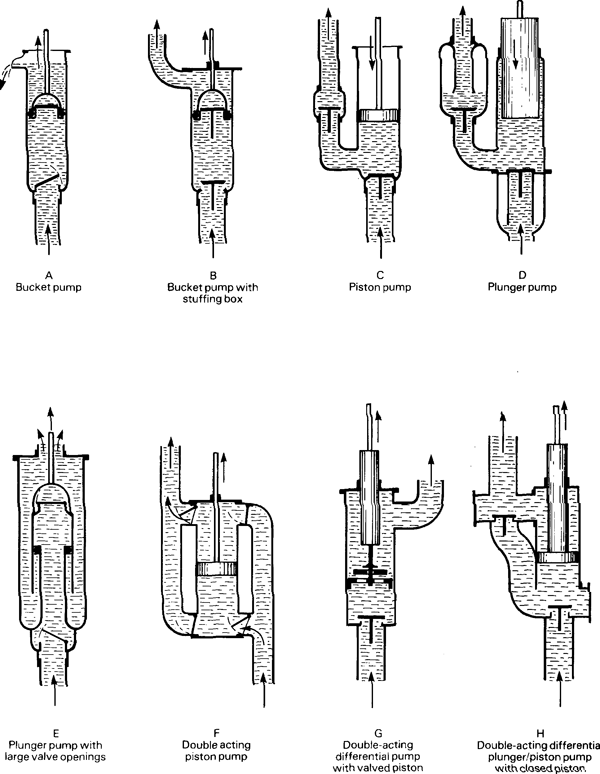
Not all hand pumps are the same. The type you need depends on well depth, water table level, and maintenance access. Choosing the right one ensures long-term reliability and ease of use.
Shallow Well Suction Pumps
Suction pumps are designed for wells less than 8 meters, or 26 feet, deep. The cylinder is located above ground inside the pump head, and they rely on atmospheric pressure to suck water up the pipe. The maximum functional depth is about 7 to 8 meters, limited by air pressure.
These pumps offer easy servicing with all critical parts accessible above ground and a simple design with lower maintenance needs. However, they cannot access deep aquifers, are prone to air leaks, and require frequent priming. If the riser pipe has even a small crack, the vacuum breaks and the pump will not draw water.
Deep Well Lift Pumps
For deeper sources, lift pumps place the cylinder below the water table where it directly displaces water rather than relying on suction. These are the standard for rural water supply and off-grid homes, with depth ranges from 10 meters to over 325 feet.
Common models include India Mark II and III, Afridev, Bush Pump, Simple Pump, and Bison Pump. These pumps exceed the atmospheric suction limit by pushing water upward rather than sucking it. They are built for durability and often follow VLOM principles, allowing local repairs without specialized tools.
Dual-Action and High-Efficiency Models
Modern designs like the Simple Pump and Bison Pump use four check valves, two in the piston and two in the cylinder, to deliver water on both strokes. During the upstroke, water is drawn into the lower chamber while upper water is pushed up. During the downstroke, water transfers from lower to upper chamber while advancing flow toward the surface.
The result is double the output per stroke, reduced effort, and smoother flow. The Tara Pump takes efficiency further with a PVC pump rod slightly smaller than the riser. On the downstroke, the rod displaces water in the riser itself, adding extra flow without additional force from the user.
Understanding Depth Limits and Suction Constraints
Understanding depth capabilities helps you choose the right pump and avoid performance issues. There are physical constraints that every hand pump user should know about.
Atmospheric Pressure and the 33-Foot Rule
At sea level, atmospheric pressure can support a water column of about 10.3 meters, or 33.9 feet. This is the theoretical maximum for suction pumps. In practice, inefficiencies limit functional depth to 7 to 8 meters, or 23 to 26 feet.
Beyond this depth, lift pumps take over. They do not rely on suction alone. They mechanically displace water, allowing extraction from over 300 feet deep. Modern deep-well hand pumps like the Simple Pump can extract water from depths up to 325 feet.
Factors Affecting Pumping Effort
Several factors influence how hard you need to work to pump water. The water column itself weighs about 9.8 kPa per meter of depth. Rod material matters, with PVC reducing weight while steel offers durability. Stroke length and bore size affect both output and effort. Larger bore means more water per stroke but more effort required. User strength and technique also play a role, as rhythm reduces fatigue over time.
Pumping from 200 feet or more requires sustained effort, but it becomes manageable with practice.
Priming Your Pump for First Use
Even the best pump will not work without proper priming, the process of filling the system with water to create an initial seal. This step is crucial for starting the flow.
Why Priming Is Necessary
Air is compressible, but water is not. If the cylinder contains air, the piston cannot create a strong vacuum during the upstroke. Pouring 1 to 2 cups of water into the pump head before first use fills the chambers, seals the valves, and allows pressure differentials to form.
Modern sealed systems like the Simple Pump are self-priming due to superior valve design and airtight construction. Keep a small container of water near the pump for quick priming when needed.
When to Prime
You should prime the pump after installation, following long periods of inactivity, or if the pump suddenly stops drawing water. Regular priming maintains the vacuum seal and ensures consistent performance.
Maintenance Tips for Long-Term Reliability
A well-maintained hand pump can last decades. Regular care prevents breakdowns and ensures consistent performance year after year.
Valve and Seal Inspection
Valves are the most common failure point. Inspect them every 3 to 5 years for cracks or warping, debris blocking valve seats, and hardened or swollen seals. Replace worn leather seals with modern synthetic rubber for longer life and better sealing.
Rod Alignment and Corrosion Control
A bent pump rod increases friction and wear. Check alignment annually. In areas with high iron, salinity, or acidity, use stainless steel rods, PVC components, and galvanized or coated pipes to prevent corrosion.
Freeze Protection with Weep Holes
In cold climates, a weep hole drilled below the frost line allows water to drain after use. Without it, trapped water can freeze, crack pipes, and destroy the pump. Position the weep hole at least 12 inches below frost depth for proper protection.
VLOM Design: Why Local Repair Matters
Village Level Operation and Maintenance, known as VLOM, is a design philosophy ensuring pumps can be repaired locally without engineers or heavy equipment.
Principles of VLOM
Open-top cylinders allow piston and foot valve removal via the pump rod. Standardized parts enable local fabrication. Minimal tools are required, typically just a wrench, hammer, and rope. The approach is training-focused, with communities learning to maintain their own systems.
Benefits for Pump Owners
VLOM design reduces downtime, lowers repair costs, builds community ownership, and extends pump lifespan. Models like Afridev and India Mark III follow VLOM principles, making them ideal for rural development and independent living situations.
Choosing the Right Pump for Your Well
Selecting a hand water pump depends on several key factors that match your specific situation.
| Factor | Recommendation |
|---|---|
| Well depth | Less than 26 feet: suction pump. Greater than 26 feet: lift pump |
| Maintenance access | Choose VLOM-compliant open-top designs |
| Water quality | Use corrosion-resistant materials in aggressive water |
| User strength | Consider dual-action models for less effort |
| Climate | Include weep hole in freezing zones |
| Budget | DIY installation saves significant costs |
Top brands like Simple Pump and Bison Pump offer deep-well capability, self-priming features, and U.S.-based support. A Simple Pump system for a 300-foot well costs over $2,000, excluding original well drilling, but self-installation can reduce overall expenses.
Frequently Asked Questions About Hand Water Pumps
How deep can a hand water pump pull water?
Suction pumps are limited to about 7 to 8 meters, or 23 to 26 feet, due to atmospheric pressure. Lift pumps can extract water from over 300 feet deep by mechanically displacing water rather than relying on suction alone.
Do hand water pumps need to be primed?
Traditional single-action pumps require priming with 1 to 2 cups of water before first use and after periods of inactivity. Modern sealed systems like the Simple Pump are self-priming and do not require this step.
Why does water only come out during the downstroke?
In single-action pumps, the piston valve closes during the upstroke, trapping water above the piston. During the downstroke, pressure opens the valve and pushes water up the riser. Dual-action pumps deliver water on both strokes for continuous flow.
How often should hand pump valves be replaced?
Inspect valves every 3 to 5 years for wear, cracks, or debris. Replace seals when they become hardened, cracked, or swollen. Synthetic rubber seals last longer than traditional leather.
Can hand pumps freeze in winter?
Yes, if water remains in the pump and riser pipe. Install a weep hole below the frost line to allow residual water to drain after each use. This prevents freezing, cracking, and damage to the pump.
How much water can a hand pump deliver per stroke?
Output ranges from 0.5 to 2 liters per stroke depending on pump design, bore size, stroke length, and depth. Flow becomes continuous after priming and several pumping cycles.
Key Takeaways for Understanding Hand Water Pumps
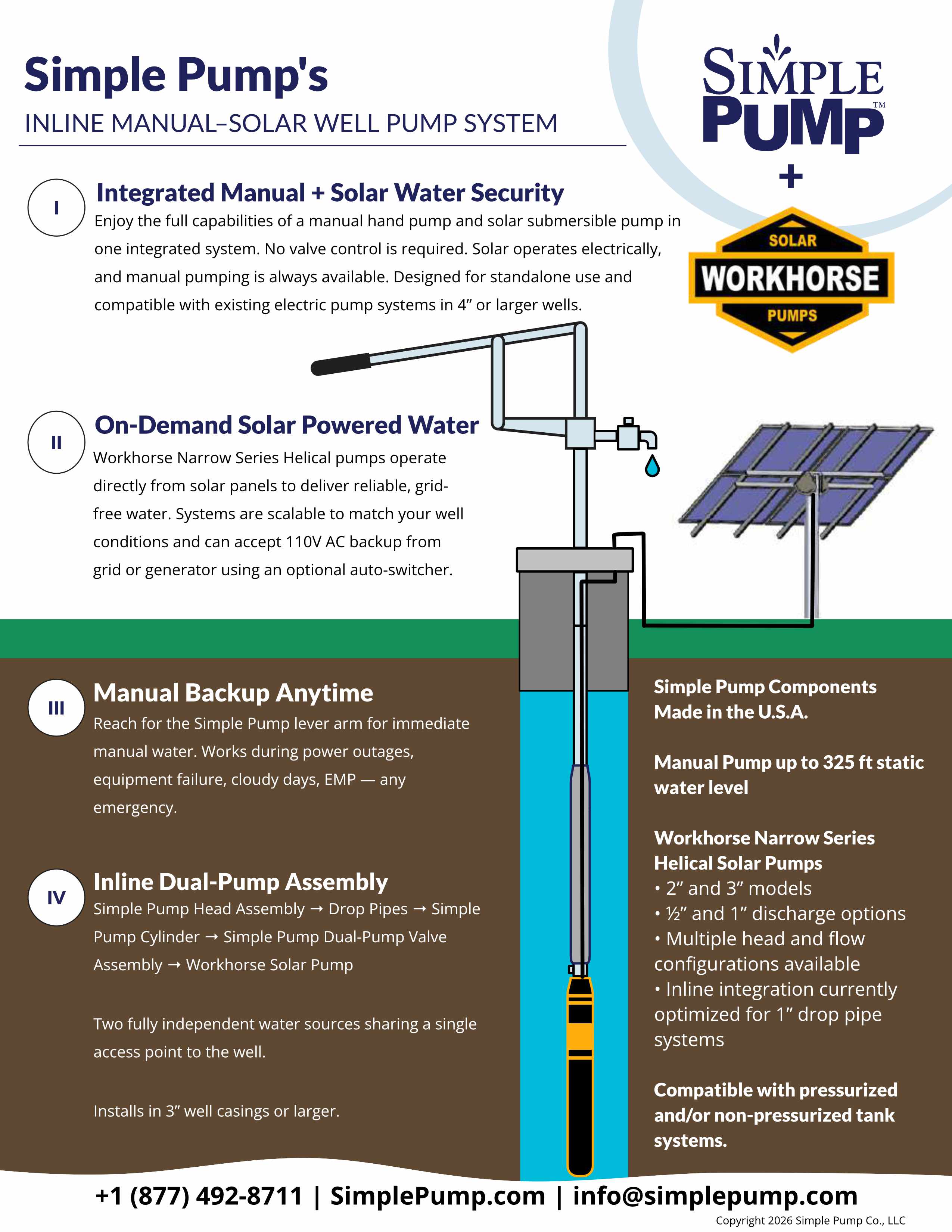
A hand water pump is more than a simple tool. It is a lifeline that harnesses basic physics and durable engineering to deliver reliable water without electricity. The system relies on two one-way check valves and a piston to create alternating pressure zones that move water upward stroke by stroke.
Choosing the right pump depends primarily on your well depth. Shallow wells under 26 feet can use suction pumps, while deeper wells require lift pumps that displace water mechanically. Modern dual-action designs double output by delivering water on both strokes, making them easier to operate.
Maintenance is straightforward but essential. Inspect valves every few years, keep the rod aligned, and protect against freezing with a properly placed weep hole. VLOM-compliant designs allow local repairs without specialized tools, reducing dependency on external technicians.
Whether you are preparing for emergencies, living off-grid, or supporting sustainable development, understanding how a hand water pump works ensures you can install, maintain, and depend on it for years to come.