If your basement floods during heavy rain or your well suddenly stops delivering water, a submersible water pump might be the unsung hero or the silent failure behind the scenes. Unlike traditional pumps that sit above ground, submersible pumps operate fully immersed in water, pushing fluid upward with quiet efficiency. This design eliminates common issues like cavitation and the need for manual priming, making it ideal for deep wells, sewage systems, and industrial dewatering.
So how does a submersible water pump work? At its core, it uses a sealed electric motor to spin an impeller, which accelerates water outward using centrifugal force. That fast-moving water then passes through diffusers that convert speed into pressure, lifting the water to the surface. With each additional impeller stage, the pump can push water higher, making multistage models perfect for deep boreholes or high-rise buildings.
The Core Mechanism Behind Submersible Water Pumps
A submersible water pump works by converting electrical energy into hydraulic pressure through centrifugal force. The entire unit sits underwater, which fundamentally changes how it moves fluid compared to surface pumps.
Centrifugal Force Drives Fluid Movement
The electric motor, hermetically sealed and waterproof, spins a shaft connected to one or more impellers. As the impeller rotates at high speed, water enters through the intake screen at the bottom and is flung radially outward. This outward motion increases the water’s velocity, creating kinetic energy. Because the pump is submerged, there is no air to trap or prime; water flows in naturally due to the low-pressure zone created by the spinning impeller.
Diffusers Convert Speed to Pressure
Once the water leaves the impeller, it enters the diffuser, a stationary ring with vanes surrounding the impeller. These vanes slow down the fast-moving water, transforming kinetic energy into pressure energy. The higher the pressure, the higher the water can be lifted. In single-stage pumps, this process happens once. In multistage submersible pumps, multiple impeller-diffuser sets are stacked on the same shaft, each stage adding more pressure to lift water from depths exceeding 1,000 feet.
Why Submersible Pumps Push Instead of Pull
Traditional surface pumps rely on suction to pull water up from below, which is limited by atmospheric pressure and prone to cavitation. Submersible pumps eliminate this weakness by being placed directly in the water. Instead of pulling, they push water upward from within the source, operating under positive inlet pressure. This avoids cavitation entirely and achieves much greater efficiency, especially in deep applications.
Key Components That Make Submersible Pumps Work
Understanding each component helps you diagnose problems and select the right pump for your application.
Sealed Electric Motor
The heart of the system is the hermetically sealed motor, designed to run continuously underwater. It is typically an induction motor powered by single-phase 110V or 230V AC current for residential use, or three-phase 460V+ for industrial applications. Motors are either oil-filled, which offers superior insulation and corrosion protection for deep-well and irrigation systems, or water-filled, which is simpler and cheaper but less durable in harsh conditions.
Impeller Types and Their Applications
The impeller is the rotating element that imparts energy to the water. Submersible pumps use three main types. Closed impellers offer the highest efficiency and work best for clean water. Semi-open impellers handle light solids and are common in sump and irrigation pumps. Open or vortex impellers allow passage of large debris without clogging, making them ideal for sewage and dewatering. Some specialized models, like grinder pumps, include rotating cutters that macerate solids before pumping.
Mechanical Seals and Bearings
Two critical safeguards protect the motor. Mechanical seals prevent water from entering the motor compartment, with most units having dual seals for redundancy. Bearings support the rotating shaft and reduce friction, with ceramic or stainless steel options resisting wear in abrasive environments. Seal failure is the leading cause of motor burnout, so proper installation and maintenance are essential.
Intake Screen and Discharge System
Located at the pump’s base, the intake screen prevents large particles like gravel, leaves, or rags from entering the impeller chamber. In dirty water applications, a clogged intake can reduce flow or cause overheating. Pressurized water exits through the discharge outlet, typically threaded for connection to a drop pipe. An in-built check valve stops water from flowing back when the pump shuts off, preventing water hammer, repeated cycling, and dry running.
Step-by-Step: How Water Gets Moved Underground
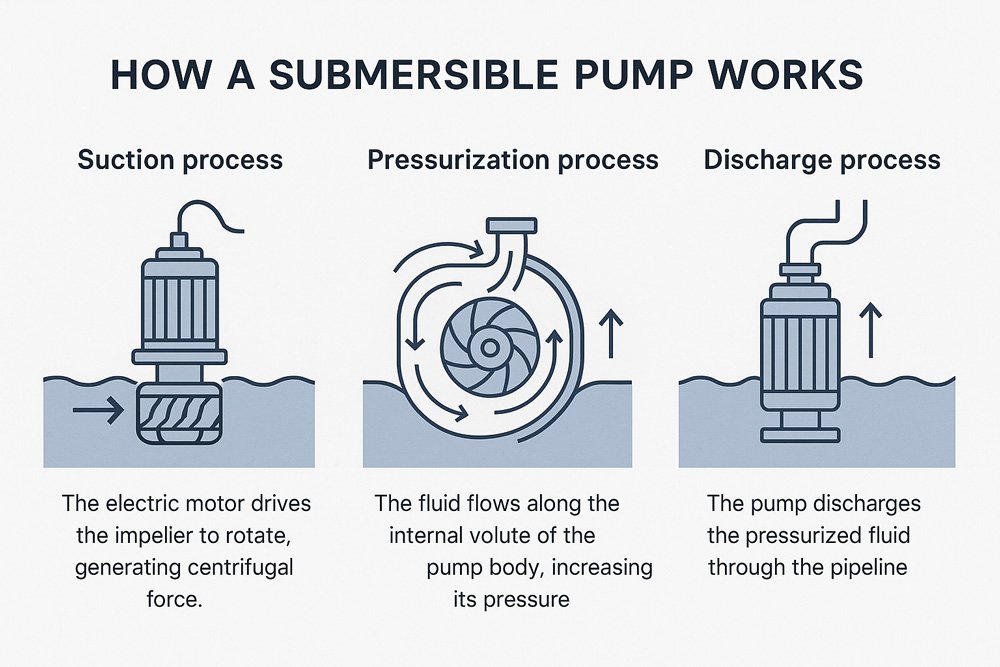
The operational process follows a precise sequence from startup to continuous operation.
1. Submerge the Pump Completely
Before operation, the pump must be fully immersed in water. For well pumps, it is lowered on a pipe string. For sump pumps, it sits on the tank floor. At least 2 to 3 feet of water above the motor is needed for proper cooling.
2. Power On Through Control Panel
Electricity flows from a surface-mounted control box or switch. Many residential units include a float switch that automatically turns the pump on when water rises and off when the level drops. Industrial systems may use pressure sensors, timers, or variable frequency drives for advanced control.
3. Motor Spins the Impeller Shaft
Once powered, the sealed motor spins the shaft at speeds ranging from 1,750 to 3,500 RPM. The exact speed depends on motor design and power supply.
4. Water Enters Through Intake Screen
Centrifugal force creates a low-pressure zone at the center of the impeller, drawing water in from the surrounding environment. Because the pump is already underwater, no priming is needed, and it starts pumping immediately.
5. Impeller Accelerates Water Radially
The impeller blades fling water outward, increasing its velocity. This kinetic energy is the first step in generating lift.
6. Diffuser Converts Velocity to Pressure
As water enters the diffuser, the narrowing vanes slow it down. The reduction in speed results in a rise in pressure, which is how the pump builds enough force to push water upward.
7. Multistage Pumps Add Pressure Gradually
In multistage models, water moves from one impeller-diffuser set to the next, gaining pressure at each stage. After the final stage, it enters the discharge pipe and rises to the surface or distribution point.
8. Check Valve Prevents Backflow
When the pump stops, the check valve closes automatically, keeping the column of water in the pipe. This ensures the system remains primed and ready for the next cycle while the surrounding water continues to cool the motor throughout operation.
Why Submersible Pumps Outperform Surface Pumps
Submersible pumps offer several distinct advantages over traditional surface-mounted alternatives.
No Priming Required
Because the pump is already underwater, there is no air in the system. This makes submersible pumps self-priming by design, eliminating the need for manual priming or vacuum-assisted startup.
Eliminates Cavitation Risk
Surface pumps struggle with cavitation, a phenomenon where low suction pressure causes water to vaporize, forming bubbles that implode and damage impellers. Submersible pumps operate under positive pressure, making cavitation virtually impossible.
Higher Efficiency
Submersible pumps waste less energy overcoming atmospheric pressure or suction losses. Typical efficiency ranges from 50% to 80%, compared to 30% to 50% for many jet pumps. They also deliver higher flow rates at greater depths, especially in multistage configurations.
Quiet and Space-Saving
Operating underwater dampens noise and vibration. A submersible pump in a deep well is nearly silent at ground level, ideal for residential areas. No need for a pump house or above-ground enclosure since the entire unit fits inside a well casing or sump basin.
Common Types of Submersible Water Pumps

Different applications require different pump designs, each optimized for specific conditions.
Deep Well Borehole Pumps
Long, narrow pumps with multiple impeller stages extract groundwater from depths over 100 feet. They are commonly used in rural homes, farms, and municipal water systems.
Sump Pumps
Compact, automatic units installed in basements or crawl spaces are activated by a float switch when water rises. They are ideal for flood prevention.
Sewage Ejector Pumps
These pumps handle wastewater containing solids using vortex or channel impellers to pass debris up to 2 inches in diameter.
Grinder Pumps
Feature rotating cutters that shred toilet paper, wipes, and other waste into slurry before pumping. They are used in homes connected to small-diameter sewer lines.
Dewatering Pumps
High-flow units for construction sites, mines, or flooded areas handle muddy or sandy water effectively.
Electric Submersible Pumps
Used in oil wells to lift crude from depths over 10,000 feet, these high-capacity multistage systems power over 90% of global oil wells for artificial lift.
Critical Limitations and Failure Risks to Know
Submersible pumps offer excellent performance but come with specific challenges that require attention.
High Initial Cost
Submersible pumps cost more upfront than surface alternatives due to sealed motors, corrosion-resistant materials, mechanical seals, and submersible cable. However, their longer lifespan and lower operating costs often justify the investment.
Difficult Maintenance Access
Unlike surface pumps, submersible units require hoisting equipment to retrieve them from deep wells or sumps. This makes routine maintenance challenging and repairs time-consuming.
Seal Failure Leads to Motor Damage
Even a tiny breach in the mechanical seal can let water into the motor, causing a short circuit. Once flooded, the motor usually cannot be repaired and must be replaced.
Cannot Run Dry
If the water level drops below the pump intake, the motor loses its cooling medium. Running dry for just a few minutes can overheat and destroy the motor. Always use dry-run protection sensors or float switches to prevent operation without adequate submersion.
Corrosion in Harsh Environments
Saltwater, acidic mine drainage, or sewage can corrode standard materials. For these applications, specify stainless steel 316, duplex alloys, or epoxy-coated housings.
Best Practices for Installing Submersible Pumps
Proper installation ensures optimal performance and extends pump life.
Size the Pump Correctly
Match the pump’s flow rate in GPM and head in feet to your system requirements. Use total dynamic head calculations to account for vertical lift, pipe friction, and pressure requirements.
Position Above the Well Bottom
Install the pump at least 10 to 20 feet above the well bottom to avoid sediment intake. Use a screened intake and ensure it sits below the minimum water level.
Secure the Power Cable
Attach the cable to the discharge pipe every 10 to 15 feet with approved clamps. Never let it hang freely, as this causes strain and abrasion.
Install Check Valves
Use an in-built or inline check valve to prevent backflow. Add additional valves every 100 feet in tall buildings.
Use Float Switches or Sensors
For sump and sewage applications, connect to a float switch for automatic control. Include dry-run protection to shut off the pump if water levels drop too low.
Test Before Final Deployment
Run the pump briefly after installation to verify proper water flow, no unusual noise or vibration, and correct rotation direction.
How to Choose the Right Submersible Pump for Your Needs
Selecting the correct pump involves matching specifications to your specific application requirements.
Match Flow Rate to Demand
Determine your required gallons per minute based on household usage, irrigation needs, or industrial demand. Oversized pumps waste energy, while undersized ones fail to meet demand.
Calculate Total Head Height
Account for vertical lift from the pump to the discharge point, plus pipe friction losses and any pressure requirements at the outlet. Multistage pumps handle heads exceeding 1,000 feet.
Consider Fluid Conditions
Clean water applications allow use of efficient closed impellers. Wastewater requires vortex or grinder impellers that can handle solids. Corrosive environments need stainless steel 316 or specialized alloys.
Evaluate Power Supply
Residential units typically use 110V or 230V single-phase power. Larger industrial applications require three-phase 460V or higher supply.
Frequently Asked Questions About Submersible Water Pumps
Can a submersible pump run dry temporarily?
No, running dry even for a few minutes can overheat and destroy the motor because it loses its cooling medium. Always install dry-run protection sensors or float switches to prevent operation without adequate water coverage.
How deep can a submersible pump lift water?
Single-stage pumps typically lift water 20 to 100 feet. Multistage submersible pumps can lift water from depths exceeding 1,000 feet, making them suitable for deep boreholes and high-rise buildings.
What causes a submersible pump to fail most commonly?
Seal failure is the leading cause, allowing water to enter the motor and cause a short circuit. Other common issues include bearing wear, impeller damage from debris, and corrosion in harsh environments.
How long do submersible pumps typically last?
With proper installation and maintenance, submersible pumps last 10 to 15 years. Oil-filled motors generally outlast water-filled models, and regular inspection extends service life.
Do submersible pumps need maintenance?
Yes, though maintenance is more difficult than surface pumps. Regular inspection of seals, bearings, and intake screens helps prevent failures. Many systems rely on predictive monitoring to detect issues early since pulling the pump is labor-intensive.
Key Takeaways on Submersible Water Pump Operation
A submersible water pump works by using a sealed electric motor to spin impellers underwater, pushing water upward through diffusers that convert velocity into pressure. This design eliminates the need for priming, prevents cavitation, and achieves high efficiency in deep applications. The key components include the hermetically sealed motor, impellers, diffusers, mechanical seals, intake screen, and check valve, all working together to move fluid reliably.
While submersible pumps cost more upfront and require more challenging maintenance access compared to surface pumps, their self-priming capability, quiet operation, and ability to handle great depths make them the preferred choice for deep wells, wastewater systems, and industrial operations. Choosing the right type based on your depth requirements, fluid conditions, and power supply ensures optimal performance and longevity.
Understanding how a submersible water pump works empowers you to make informed decisions about selection, installation, and maintenance. Whether you are a homeowner dealing with basement flooding or an engineer specifying equipment for municipal water systems, the principles outlined here will help you get the most out of your submersible pump system.
