If your water pump delivers too much or too little flow, simply turning it on and off will not solve the problem. The real solution lies in understanding how to control flow rate effectively, whether you are managing irrigation, chemical dosing, or industrial fluid transfer. Controlling the flow rate of a water pump requires matching the right method to your pump type, system demands, and efficiency goals. Centrifugal and positive displacement pumps respond very differently to control techniques, and choosing incorrectly can waste energy, damage equipment, or ruin process accuracy.
This guide breaks down every proven method, from simple valve throttling to smart automation with VFDs and back pressure regulators, so you can optimize performance, reduce wear, and save power.
Match Control Method to Your Pump Type
The first rule in flow control is simple: use the right technique for your pump. Applying a method designed for centrifugal pumps to a diaphragm pump can cause immediate failure. Know your pump type before selecting any control strategy.
Centrifugal Pumps: Control via System or Speed
Centrifugal pumps generate flow by spinning an impeller to create pressure. Their output depends on both pump speed and system resistance. You cannot directly set the flow; you must shift the operating point where the pump curve meets the system curve.
Key characteristics include:
– Flow drops as backpressure increases
– Maximum efficiency occurs at the Best Efficiency Point (BEP)
– Operating far from BEP increases vibration, seal wear, and energy use
A centrifugal pump may deliver 3 GPM at 60 psi, but only 1.5 GPM if downstream pressure rises to 80 psi. This relationship between pressure and flow is fundamental to understanding how to control flow rate on these systems.
Positive Displacement Pumps: Direct Flow Control
Pumps like diaphragm, piston, or peristaltic types move a fixed volume per stroke or revolution. Flow is directly proportional to speed (RPM) or stroke frequency.
These pumps offer distinct advantages:
– Flow remains nearly constant even with changing pressure
– Ideal for precision applications like dosing or medical infusion
– Easily controlled by adjusting motor speed via voltage or PWM
Never throttle positive displacement pumps on the discharge side. Pressure builds until something fails, causing seal blowout or motor overload.
Adjust Flow with Discharge Valve Throttling
Throttling the outlet is the most common but not always best way to reduce flow in centrifugal systems. This method works by increasing system resistance, which shifts the operating point up the pump curve.
How Outlet Valves Reduce Flow
Closing a valve on the discharge side increases system resistance. This shifts the operating point up the pump curve, reducing flow while increasing pressure.
Use these valve types for best results:
– Globe valves for precise control
– Needle valves for fine adjustments
– Modulating control valves with actuators for automated systems
Never throttle positive displacement pumps. Pressure builds dangerously until something fails.
Pros and Cons of Valve Control
Valve throttling offers advantages and disadvantages that must be weighed:
This method costs little and installs easily on existing systems. However, it wastes energy as heat across the valve and reduces efficiency, especially at low flow rates. The risk of cavitation increases below 20 to 30 percent of rated flow, and both the valve and impeller wear faster.
Avoid Cavitation When Throttling
Excessive throttling reduces flow so much that liquid vaporizes at the impeller inlet, causing cavitation. This causes pitting, noise, and vibration that damages impellers and seals over time.
Prevention tips include:
– Never throttle below minimum continuous flow, typically 20 to 30 percent of maximum
– Monitor for rattling sounds or reduced output
– Use a bypass line if low-flow operation is frequent
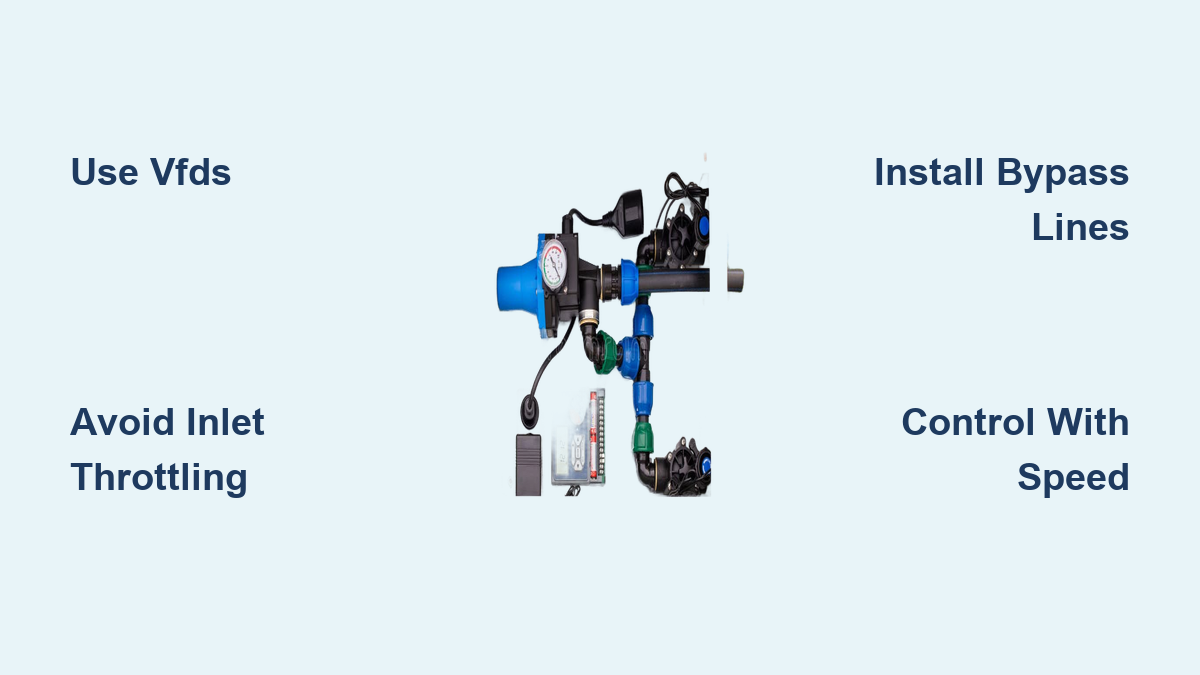
Use Bypass Lines to Recirculate Excess Flow
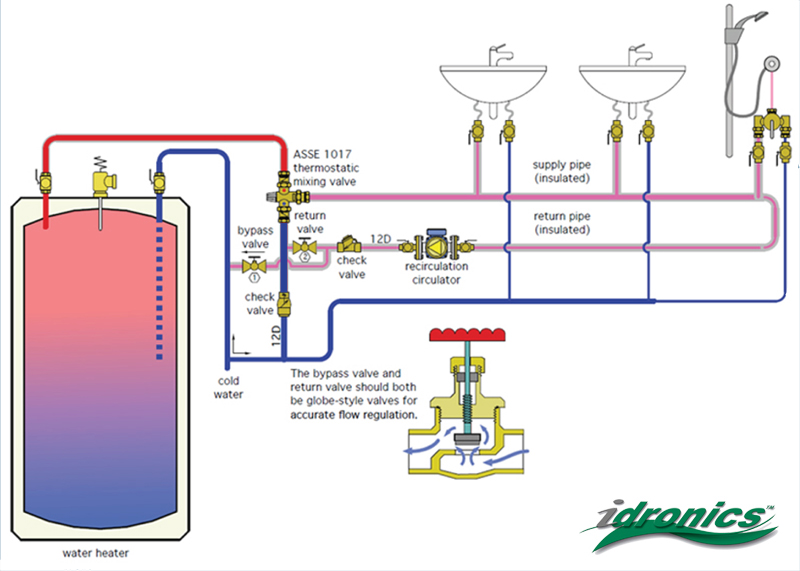
Bypass recirculation keeps the pump running safely while diverting unused water back to the source. This approach protects the pump from running dry while allowing flow adjustment.
How Recirculation Maintains Minimum Flow
A bypass line with a control valve returns part of the discharge flow to the suction tank. This ensures the pump always moves enough water for cooling and lubrication.
Key components needed are:
– Control valve (manual or automated)
– Check valve to prevent reverse flow
– Properly sized pipe matching pump capacity
When to Use Bypass Control
This method works well for:
– Constant-speed pumps with variable demand
– Systems requiring uninterrupted flow for safety
– Applications where temperature rise from recirculation is acceptable
The pump runs at full power even when demand is low, so significant energy savings do not occur. Recirculating hot water can also overheat the fluid. Install a thermal relief valve if needed.
Optimize Efficiency with Speed Control
Speed variation is the most efficient way to control flow, especially for centrifugal pumps. This method changes the entire pump performance curve rather than restricting it.
Variable Frequency Drives (VFDs) for AC Motors
A VFD changes motor speed by adjusting the frequency of AC power supplied to the motor. Input accepts 120V, 230V, or 480V AC in single or three-phase configurations. Output ranges from 0 to 400 Hz, controlling RPM from 0 to 100 percent.
Control signals include 0 to 10 V, 4 to 20 mA, or Modbus communication. Benefits include soft start that reduces mechanical stress and inrush current, operation near BEP across flow ranges, and elimination of water hammer and pressure surges.
DC and PWM Speed Control for Small Pumps
For DC diaphragm or peristaltic pumps, speed adjusts through voltage regulation or Pulse Width Modulation. Lower voltage means slower motor speed. PWM uses rapid on/off pulses where the average power sets speed, allowing fine control down to 5 to 10 percent of max flow.
Affinity Laws: Why Speed Control Saves Power
Centrifugal pump performance follows the affinity laws. Flow is proportional to speed, head is proportional to speed squared, and power is proportional to speed cubed.
Cutting speed by 20 percent reduces power use by 49 percent (0.8 cubed equals 0.512). A 1 HP pump running at 80 percent speed uses only about 0.51 HP, nearly half the energy for approximately 80 percent of the flow.
Stabilize Flow with Back Pressure Regulators
A back pressure regulator maintains constant upstream pressure, stabilizing flow regardless of downstream changes. This approach works without flow meters and handles aggressive fluids well.
How BPRs Work Without Flow Meters
The Equilibar BD Series BPR uses a dome-loaded diaphragm. Pilot pressure (such as 50 psi air) sets the discharge pressure. The diaphragm opens or closes multiple orifices to maintain the setpoint with no friction, hysteresis, or stiction.
Real-World BPR Demonstration
Setting pilot to 50 psi causes flow to stabilize at 4 GPM. Increasing to 65 psi drops flow significantly. Returning to 50 psi instantly returns flow to 4 GPM. Even when a downstream gate valve adjusts, flow remains unchanged if pilot pressure stays fixed.
Ideal Applications for BPRs
Back pressure regulators excel in:
– Corrosive or abrasive fluids where flow meters degrade quickly
– Ultra-pure systems in pharmaceuticals and semiconductor manufacturing
– Mixed-phase gas-liquid flows
Use electronic air regulators to dynamically adjust pilot pressure for automation.
Automate Control with Sensors and Feedback
Closed-loop systems use real-time data to maintain precise flow under changing conditions. This approach delivers the highest accuracy for critical applications.
Flow Sensors for Real-Time Monitoring
Choose based on fluid type and accuracy needs:
– Magnetic flow meters for high accuracy with conductive liquids
– Ultrasonic clamp-on meters for non-invasive retrofits
– Coriolis meters for mass flow measurement and precision
– Turbine meters for low-cost clean water applications
PID Controllers for Stable Regulation
A PID loop compares measured flow to a setpoint and adjusts VFD speed, control valve position, or pump on/off cycles. This ensures accurate flow despite viscosity changes, supply pressure fluctuations, or pipe fouling.
A chemical dosing system maintains plus or minus 1 percent flow accuracy using 4 to 20 mA feedback.
PLCs for Complex Automation
Programmable Logic Controllers manage multiple pumps, valves, and sensors. They run cascade control, log data, trigger alarms, and enable remote monitoring. Water treatment, pharmaceuticals, and food processing commonly use PLCs.
Avoid Inlet Throttling at All Costs
Closing a valve on the suction side is dangerous and ineffective. This method reduces Net Positive Suction Head Available, causing liquid to vaporize at the impeller inlet.
Why Suction Throttling Causes Cavitation
The consequences are severe:
– Impeller pitting and noise
– Seal and bearing failure
– Reduced efficiency and shortened lifespan
Always control flow on the discharge side or via speed, never the suction side.
Use Multi-Speed Motors for Step Control
Some motors offer 2 or 3 fixed speeds instead of continuous variation. This approach provides a middle ground between simple on/off control and full VFD capability.
How Dual-Speed Motors Work
These motors switch between winding configurations. Speeds might be 1800 RPM and 3600 RPM on 60 Hz power, achieved by switching between 4-pole and 2-pole configurations.
This works for HVAC systems with daytime and nighttime loads, and irrigation zones with different flow needs. However, only discrete flow levels are available, and mechanical switching causes transient stress.
Cycle Pumps On and Off for Average Flow
Intermittent operation achieves average flow by turning the pump on and off. This simple approach works for many basic applications.
When On/Off Control Works
This method suits:
– Tank filling operations
– Irrigation cycles
– Domestic water pressure systems
Control uses timer-based cycling, pressure switches, or level sensors.
Risks of Frequent Cycling
Frequent cycling causes electrical stress from inrush current, mechanical wear on seals and bearings, and potential water hammer from sudden stops.
Install a pressure tank or bladder accumulator to store water under pressure, delay pump restart, and smooth delivery. Target no more than 10 to 15 starts per hour to extend motor life.
Precision Control with Peristaltic Pumps
For low-flow, high-accuracy applications, peristaltic pumps are unmatched. They offer unique advantages that other pump types cannot match.
Why Peristaltic Pumps Excel
These pumps provide a linear speed-flow relationship where double RPM equals double flow. No valves or seals touch the fluid, so only the tubing contacts the fluid. They are self-priming and reversible, handling viscous, abrasive, or shear-sensitive fluids.
Control Options
Peristaltic pumps accept analog input for smooth speed ramping, digital communication like Modbus or RS485 for integration, and pulse input for synchronized dosing.
Replace tubing every 200 to 2000 hours depending on fluid and pressure. Signs of wear include cracks, flat spots, and reduced flow. Use chemically compatible tubing such as Viton or PharMed.
Maintain Long-Term Reliability
Even the best system fails without proper maintenance. Regular upkeep extends equipment life and ensures consistent performance.
VFD Care
Clean cooling fans and heat sinks every 6 months. Check for harmonic distortion in power lines. VFDs last 10 or more years with proper ventilation.
Valve Inspection
Look for seat erosion and stem packing leaks. Test actuator response in automated systems.
Peristaltic Pump Tubing
Replace tubing every 200 to 2000 hours. Inspect for compression set, which appears as flattened tubing.
Back Pressure Regulator Maintenance
Clean diaphragm and orifices annually. Check for clogging in high-particulate systems. Equilibar BPRs last millions of cycles, ideal for continuous operation.
Frequently Asked Questions About Controlling Water Pump Flow Rate
What is the most energy-efficient way to control water pump flow?
Variable Frequency Drives (VFDs) offer the highest energy efficiency. Cutting pump speed by 20 percent reduces power consumption by approximately 49 percent due to the affinity laws. This method also enables soft start, reducing mechanical stress and electrical inrush current.
Can I use valve throttling on any type of pump?
No. Valve throttling only works safely on centrifugal pumps. Throttling positive displacement pumps causes pressure to build until seals fail or motors overload. Always use speed control for diaphragm, piston, or peristaltic pumps.
How do I prevent cavitation when controlling flow?
Never throttle below minimum continuous flow, typically 20 to 30 percent of maximum flow. Monitor for rattling sounds or reduced output, and use a bypass line if low-flow operation is frequent. Always control flow on the discharge side rather than the suction side.
What control method works best without a flow meter?
Back pressure regulators maintain constant upstream pressure, stabilizing flow without flow meters. The Equilibar BD Series uses dome-loaded diaphragms to provide stable, repeatable flow regardless of downstream changes. This works especially well for corrosive, abrasive, or ultra-pure fluids.
How often should I replace peristaltic pump tubing?
Replace peristaltic pump tubing every 200 to 2000 hours depending on fluid type, pressure, and operating speed. Signs of wear include cracks, flat spots, and reduced flow. Using chemically incompatible tubing causes faster degradation.
Is inlet throttling ever acceptable?
No. Inlet throttling should be avoided under all circumstances. It reduces NPSHa, causing liquid to vaporize at the impeller inlet. This leads to impeller pitting, vibration, seal failure, and greatly reduced pump life.
Key Takeaways for Controlling Water Pump Flow Rate
Choosing the right flow control method depends on your pump type, accuracy requirements, and efficiency goals. Centrifugal pumps respond best to VFD speed control or back pressure regulation, while positive displacement pumps like peristaltic or diaphragm pumps work well with direct speed adjustment. Avoid inlet throttling entirely, as it causes cavitation and equipment damage.
For highest efficiency, use VFDs which can cut energy use nearly in half while maintaining adequate flow. For precision applications like pharmaceutical dosing or chemical injection, peristaltic pumps with closed-loop feedback deliver plus or minus 1 percent accuracy. Back pressure regulators offer a simple mechanical solution when flow meters are impractical.
Match your control method to your application: industrial water supply benefits from VFDs with outlet valve fine-tuning, agricultural irrigation works with timed on/off cycling, and sterile pharmaceutical production requires PLC-integrated peristaltic pumps. Regular maintenance of valves, VFDs, and tubing ensures long-term reliability and consistent performance.