Imagine turning on your kitchen tap and nothing comes out. No shower, no washing machine, no flush. At the heart of every working water system is a simple but powerful device: the water pump. This essential machine moves water by creating a pressure difference, forcing it to flow where we need it, whether from a deep underground well, through your home’s pipes, or across vast agricultural fields.
So, how does a water pump work? This guide breaks down the core principles, key pump types, real-world applications, and maintenance tips. Whether you own a home with a well, an RV, or a car with an internal combustion engine, understanding these mechanisms helps you diagnose issues, choose the right equipment, and keep water flowing efficiently for years.
The Core Principle: Pressure Differential Explained
All water pumps rely on one fundamental physical truth: fluid naturally moves from high pressure to low pressure. A pump manipulates this natural flow by creating a low-pressure zone at the inlet, which pulls water in, then increases pressure at the outlet to push it out.
This pressure shift happens through two main mechanisms. Kinetic energy transfer, used in centrifugal pumps, involves spinning impellers that accelerate water outward. Mechanical displacement, used in diaphragm and piston pumps, involves chambers that physically trap and push water forward. Without a pressure differential, no flow occurs, even if the pump is running.
Key points about pump operation:
– Priming removes air from the system and is crucial for many pump types
– Air pockets prevent suction formation, breaking the pressure cycle
– Dry running without water overheats seals and bearings
Centrifugal Pumps: How Spinning Impellers Move Water
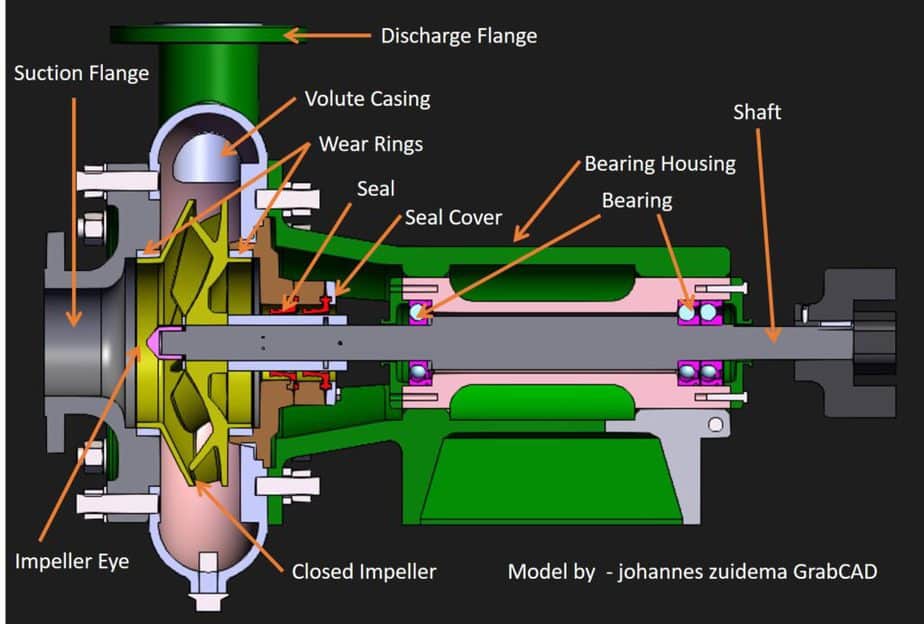
Centrifugal pumps are the most common type, found in homes, industries, and agricultural operations. They work by converting rotational energy into pressure using a fast-spinning impeller.
Impeller and Volute Function
The impeller sits at the pump’s core. As it spins, curved vanes grab water entering through the suction inlet and fling it outward with force, adding kinetic energy to the water. The water then enters the volute casing, a spiral-shaped chamber that gradually widens. As the space increases, water slows down, and according to Bernoulli’s principle, when speed drops, pressure rises. Pressurized water then exits through the discharge outlet.
Impeller Design Types
Closed impeller designs offer the highest efficiency and work best with clean water, as vanes are enclosed between two walls. Semi-open impellers have one wall only, balancing performance and clog resistance. Open impellers have no enclosing walls and handle debris in wastewater applications. Choose based on your water quality.
Positive Displacement Pumps: Trapping and Pushing Water
Unlike centrifugal pumps, positive displacement pumps move a fixed volume of water with each cycle. They excel in high-pressure, low-flow tasks and handle viscous or dirty fluids better. These pumps work by expanding a chamber to suck in water, then contracting it to push water out, with one-way check valves ensuring flow goes only forward.
Diaphragm Pumps: Flexible Membrane Action
A flexible diaphragm moves back and forth via mechanical linkage, electric solenoid, or air pressure. During the suction stroke, the diaphragm pulls back, expanding the chamber and drawing water in through the inlet valve. During the discharge stroke, the diaphragm pushes forward, compressing the chamber and forcing water out through the outlet valve.
Because the diaphragm separates water from motor parts, these pumps resist contamination, making them ideal for RVs, reverse osmosis systems, aquariums, and medical devices. They are also self-priming and can briefly run dry without damage.
Piston Pumps: High-Pressure Reciprocating Motion
Piston pumps mimic engine cylinders. A rod-driven piston moves inside a sealed chamber. During the downstroke, it creates suction, pulling water in through the inlet valve. During the upstroke, it compresses water, forcing it out through the discharge valve. Capable of generating over 500 psi, these pumps are used in high-pressure cleaners, manual well pumps, and hydraulic systems.
Peristaltic Pumps: Tube Compression Method
These pumps use rollers on a rotating rotor to squeeze a flexible tube. As the rotor turns, it compresses the tube and pushes water forward in pulses. The fluid never touches internal parts, making this ideal for sterile or corrosive liquids. Used in medical infusion devices, lab dosing systems, and chemical processing, the tubing is the only wear part and requires periodic replacement.
Submersible Well Pumps: Deep Water Solutions

Installed deep in wells, often over 100 feet, submersible pumps are fully underwater and paired with a sealed motor. They use multi-stage centrifugal impellers stacked on a single shaft, with each stage adding pressure to lift water great heights.
These pumps connect to a pressure switch and tank. The pump turns on at 40 psi and shuts off at 60 psi. Advantages include quiet operation, high efficiency, and reduced cavitation risk. With proper care, these pumps last 8 or more years.
Jet Pumps: Venturi-Based Suction Systems
Jet pumps sit above ground and use a venturi nozzle to boost suction. The pump circulates water through a narrow jet, creating a vacuum via the venturi effect. This vacuum pulls water from the well into the system. Shallow well models draw from depths under 25 feet, while deep well versions use a second pipe to inject water down and boost lift up to 110 feet. These pumps must be primed before startup, and efficiency drops with depth.
Sump and Bilge Pumps: Flood Prevention Systems
Sump Pumps: Basement Flood Prevention
Installed in a sump pit, these remove groundwater before it floods basements. They activate by float switch or pressure sensor when water rises. Submersible models sit underwater and are quieter but have shorter lifespans. Pedestal models keep the motor dry, lasting longer but producing more noise. Battery backup units keep working during power outages.
Bilge Pumps: Boat Water Removal
These remove water from a boat hull after leaks, waves, or condensation. Triggered by float switches when water rises, types include centrifugal for large boats, electric diaphragm for reliable moderate output, reciprocating for durability, and manual hand-operated models for kayaks.
RV and Automotive Water Pumps: Mobile Applications
RV Water Pumps: 12V Demand Systems
RVs use 12V DC diaphragm pumps powered by onboard batteries. They are demand-activated, turning on when a faucet opens and pressure drops, then shutting off when closed. These pumps are self-priming and tolerant of brief dry runs. Common issues include low pressure from clogged filters or worn diaphragms, and no water from dead batteries or failed motors.
Automotive Water Pumps: Engine Cooling
In cars, the water pump circulates coolant through the engine block, radiator, and heater core, keeping the engine at 195 to 220 degrees Fahrenheit to prevent overheating. Most are driven by a serpentine belt, though older models use timing belts and newer hybrids and EVs use electric motors.
Electric vs Mechanical Automotive Pumps
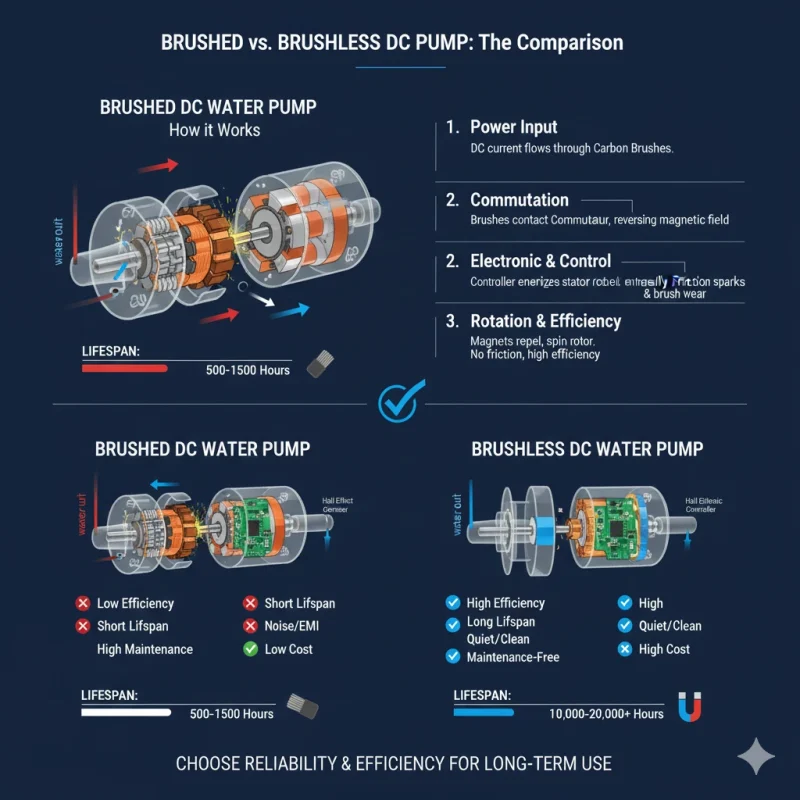
Traditional mechanical pumps run whenever the engine runs and include dual seals with a weep hole allowing minor seepage. Heavy leaks indicate failure. Modern electric pumps used in hybrids and EVs offer precise thermal control without a thermostat, reducing engine drag and improving fuel economy. They can run after engine shutdown for additional cooling.
Auxiliary pumps in EVs cool battery packs, inverters, electric motors, and turbo intercoolers. These are lightweight, plastic-housed units often mounted in compact spaces.
Reverse Osmosis Pump Systems
Standard RO systems need 50 or more psi to work efficiently. In low-pressure homes, a booster pump increases feed pressure, improving clean water output and reducing wastewater by up to 50 percent. Permeate pumps are non-electric devices that use energy from wastewater to push purified water into the tank, reducing wastewater by up to 80 percent.
Ancient Pump Designs Still in Use Today
Coil Pumps: Rotating Tube Lift
A long tube coils around a spinning axle. As it turns, water gets trapped between loops and carried upward. Powered by hand crank, animal, water wheel, or small engine, these lift water 5 to 10 meters. Still used in rural Asia for small-scale irrigation and pond drainage, they are simple, repairable with local materials, and need no electricity.
Spiral Pumps: Wirz Pump Design
Invented in 1746, this pump uses a spiraled metal sheet forming concentric chambers. Rotated by water wheel or engine, water enters the outer edge and spirals inward to the center outlet. First used in Zurich, these pumps lift water 5 to 10 meters and remain easy to maintain.
Common Failure Signs and Diagnostics
Watch for these symptoms. No water indicates loss of prime, clog, or motor failure. Low pressure suggests worn impellers, air leaks, or clogged filters. Constant running means failed pressure switches or system leaks. Grinding noises indicate bearing failure. Leaks come from seal or gasket degradation. Overheating engines point to failed automotive pumps or coolant blockage.
Cavitation occurs when vapor bubbles form in low-pressure zones and collapse violently, damaging impellers. Prevent it by avoiding air in suction lines, keeping inlets clear, and not exceeding recommended lift heights.
Maintenance Tips for Long Pump Life
A well-maintained water pump lasts 8 or more years. Inspect seals and bearings annually. Clean inlet filters every 3 to 6 months. Flush coolant per vehicle schedule, typically every 30,000 to 100,000 miles. Avoid stop-leak additives that clog weep holes and accelerate wear. Install pressure tanks to reduce cycling. Use in-line strainers to block debris. For RV and marine pumps, winterize to prevent freezing damage.
Final Thoughts on Understanding Water Pump Mechanics
Understanding how a water pump works reveals the invisible force behind modern convenience. Whether it is a spinning impeller in a well, a pulsing diaphragm in an RV, or a silent electric pump in a hybrid car, each design solves a specific need through smart engineering. The key is matching the pump type to your application, maintaining it regularly, and addressing problems early before they worsen. Keep it primed, keep it clean, and your pump will keep working quietly and efficiently for years.
Frequently Asked Questions About Water Pumps
What is the basic principle behind all water pumps?
All water pumps work by creating a pressure differential. They generate a low-pressure zone at the inlet to draw water in, then increase pressure at the outlet to push water out. This manipulates the natural flow of fluid from high pressure to low pressure.
What is the difference between centrifugal and positive displacement pumps?
Centrifugal pumps use spinning impellers to accelerate water and convert kinetic energy into pressure. Positive displacement pumps trap a fixed volume of water and physically push it out. Centrifugal pumps excel in high-flow applications, while positive displacement pumps handle high-pressure, low-flow tasks.
How do I know if my water pump is failing?
Common signs include no water flow, low pressure, constant running, grinding or whining noises, visible leaks, and overheating. For automotive pumps, check for coolant leaks under the front of the vehicle and monitor engine temperature.
Can water pumps run dry?
Most pumps should not run dry. Centrifugal pumps require priming and can be damaged by dry running. Diaphragm pumps can tolerate brief dry runs, but extended operation without water overheats seals and bearings. Always ensure proper water supply before operation.
How long does a typical water pump last?
With proper maintenance, most water pumps last 8 or more years. Submersible well pumps, sump pumps, and automotive water pumps all fall within this range when cared for according to manufacturer guidelines.
What causes cavitation in water pumps?
Cavitation happens when vapor bubbles form in low-pressure zones, typically from air in the suction line, clogged inlets, or excessive lift height. These bubbles collapse violently and damage impellers. Prevent it by ensuring proper priming, keeping inlets clear, and avoiding over-extension of pump capacity.