If your engine is overheating, squealing, or showing signs of belt misalignment, the water pump pulley could be the culprit. Whether you need to replace a cracked plastic pulley, upgrade to steel, or service the water pump itself, removing the pulley is a task that trips up many DIYers. The biggest challenge? That pulley won’t stop spinning while you try to loosen the bolts. This guide gives you proven methods to lock the pulley in place, the right tools for the job, and vehicle-specific tips that mechanics use every day.
You’ll learn exactly how to identify your pulley type, stop unwanted rotation, remove stubborn bolts without stripping them, and pull the pulley off without damaging the shaft. From Saturns to Jeep XJs to GM trucks, this covers the techniques that work in the real world.
Identify Your Water Pump Pulley Type
Before grabbing tools, figure out how your pulley attaches to the shaft. The removal method depends entirely on the design.
Bolt-On Pulley
These are secured with visible screws or a central bolt. This is the most common type, found on GM trucks, Saturns, and many older vehicles.
- Uses 3 to 5 bolts (8mm to 13mm) or Phillips head screws
- Removal is straightforward: loosen fasteners, then pull straight off
Press-Fit Pulley
No visible fasteners. The pulley presses tightly onto the shaft with an interference fit.
- Requires a pulley puller for removal
- Never hammer directly on the shaft or pulley face
Keyed or Splined Pulley
Fits over a keyway or grooves on the shaft. May be press-fit or bolted on.
- Alignment matters during reinstallation
- Check for a key that must be removed and saved
Plastic Pulley
Common on performance engines like the Ford Barra. Lightweight but prone to cracking.
- Often non-reusable
- Destructive removal is acceptable if replacing with steel
Quick check: if you see screws, it’s bolt-on. If the surface is smooth with no fasteners, it’s press-fit.
Gather the Right Tools for the Job
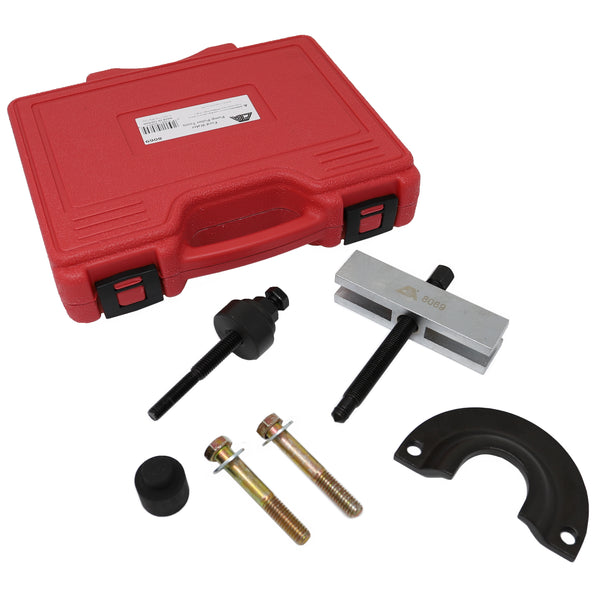
Having the proper tools transforms this from a frustrating 3-hour struggle into a 20-minute job.
Essential Hand Tools
- Box-end wrenches (8mm, 10mm, 13mm) for tight engine bays
- Socket set with 1/4″ drive for confined areas
- Breaker bar with pipe extension for stubborn bolts
- Flat-blade screwdriver for wedging
- Rubber mallet or dead-blow hammer
Specialty and Improvised Tools
- Water pump pulley puller (must grip the metal collar at the base, not the outer edge)
- Three-jaw puller for press-fit pulleys
- Strap wrench or chain vise grip
- Penetrating oil (PB Blaster or Liquid Wrench)
- Latex balloon or tightly rolled rag
- Small mill file (6 inch) with teeth that grip when pulled through the belt gap
Pro tip: O’Reilly’s, AutoZone, and Advance Auto often loan pullers for free or even remove the pulley for you when you buy a new water pump.
Safety Preparations Before Starting
This isn’t the step to rush through.
- Disconnect the negative battery terminal to prevent accidental starts
- Let the engine cool completely to avoid burns
- Raise the vehicle on jack stands never work under a car supported only by a jack
- Remove the front tire and splash shield for better access (especially on Saturns and Jeeps)
- Wear gloves and eye protection
Access the Water Pump Pulley
Clearance varies wildly between vehicles. Know your access points before starting.
Saturn S-Series
- Remove splash shield and passenger-side tire
- Use a 10mm box-end wrench sockets won’t fit in the tight space
- Serpentine belt routing allows access without full belt removal
Mercury Mystique 2.0L I4 (1996)
- Pulley blocks timing belt access
- Only 8mm bolts fit; box-end wrench required
- Use automatic tensioner to increase belt tension for anti-spin
Jeep XJ (4.0L I6)
- Smooth, reverse-rotation pulley
- Four Phillips screws prone to corrosion in humid climates
- Strap wrench or homemade spanner holds the pulley steady
GM Trucks (2000-2006 Silverado)
- 13mm central bolt plus four outer screws
- Belt routing: Power steering, Water pump, Idler, Crank, Alternator, AC, back to Power steering
- Release tensioner sideways with a 1/2 inch breaker bar and 3/8 inch adapter
Vehicles with Fan Clutch
- Fan may block access entirely
- Use a 48mm or 1-15/16 inch thin wrench
- Fan clutch threads are often left-hand turn clockwise to loosen
Stop the Pulley from Spinning
This is the number one challenge. Here is how to beat it.
Keep the Serpentine Belt On
The belt acts as a natural brake. Use a breaker bar on the crankshaft pulley to increase tension while loosening bolts.
Jam the Belt with Friction Devices
- Tightly rolled rag wedged into the gap between belt and pulley
- Latex balloon inserted and pulled tight creates a one-way lock
- Small mill file slide the teeth into the gap, then turn the crank to engage
- Rubber jar opener (silicone mat) high-friction material pulled through the gap
One mechanic reported the latex balloon method worked after all others failed.
Mechanical Immobilization
- Pry bar between bolt heads anchored against the engine block
- Chain vise grip wrapped around the pulley secured to frame or strut
- Two-wrench technique use opposing wrenches on adjacent bolts
Homemade Spanner Wrench (Jeep XJ)
Cut a steel bar to match pulley hole spacing, drill holes, and insert bolts. Brace against the engine for anti-rotation.
Remove the Pulley Bolts Step by Step
With the pulley locked in place, tackle the fasteners.
Standard Bolt Removal Procedure
- Loosen all bolts slightly first this prevents warping or binding
- Use a star pattern for 4 or more bolts ensures even pressure release
- Apply penetrating oil soak overnight if corroded
- Use breaker bar with pipe extension adds torque for stubborn bolts
- Leave one bolt partially threaded keeps pulley aligned during removal
Dealing with Stripped or Rounded Bolts
- Use a left-hand drill bit or bolt extractor
- Replace with new fasteners OEM Phillips screws strip easily
- Use a hand impact driver with a #3 Phillips bit struck with a hammer more effective than electric tools
Upgrade for Future Service
Replace Phillips screws with 5/16-18 Allen-head pan head screws on GM trucks. Easier to remove, less prone to stripping.
Pull the Pulley Off the Shaft
Bolts are out but the pulley may still be stuck.
If Pulley Slides Off Easily
It was likely only held by bolts. Inspect the shaft for wear, corrosion, or bending.
If Pulley Is Seized
Non-Puller Methods
- Tap with rubber mallet strike the back of the pulley, not the shaft
- Soak with PB Blaster let penetrate overnight
- Apply heat to hub only use a heat gun or propane torch to expand the metal
- Never heat plastic or rubber seals
- Avoid open flame near hoses
Using a Pulley Puller (Recommended)
- Select a puller that grips the metal collar at the base
- Mount arms evenly on the flange
- Center the screw against the shaft, not the threads
- Gradually tighten no jerking or lateral force
- Pulley should slide straight off
Warning: Never pry or hammer directly on the shaft this can ruin the water pump bearings.
Vehicle-Specific Removal Tips

Ford Barra (Plastic Pulley)
Destructive removal is acceptable if upgrading to steel. Use an angle grinder to cut the outer plastic ring, then pull the inner steel hub with a standard puller.
Jeep XJ (Phillips Screws)
Soak with penetrating oil first corrosion is common. Use a strap wrench or homemade spanner. Tap gently after bolt removal if stuck.
Saturn S-Series
10mm bolts use box-end wrench with pipe for leverage. Wedge a screwdriver between bolts and frame to prevent spin.
GM Trucks
After bolt removal, tap with a dead-blow hammer if seized. Upgrade to Allen-head screws for future ease.
Inspect and Prepare the Shaft for Reinstallation
Before installing a new pulley, ensure the shaft is ready.
Critical Checks
- Clean shaft with emery cloth or wire brush remove all rust and corrosion
- Inspect for scoring, bending, or pitting a damaged shaft may require water pump replacement
- Verify keyway alignment for keyed pulleys
Apply Anti-Seize Compound
Prevents future seizure, especially in humid or salty environments. Apply a thin coat to the shaft, not to the bolt threads.
Reinstall the Pulley Correctly
A poorly installed pulley leads to noise, slippage, and premature failure.
Installation Steps
- Slide pulley on straight align keyway if present
- Hand-start all bolts prevents cross-threading
- Torque to spec in star pattern avoid over-tightening (can crack plastic pulleys)
- Reinstall serpentine belt follow photo or diagram exactly
- Check belt alignment and tension ensure it sits fully in all grooves
Never reuse a bent or damaged pulley it will cause belt failure.
Test and Verify Your Work
Final checks prevent comebacks.
- Reconnect battery
- Start engine listen for squealing or grinding
- Check for vibration or belt slippage
- Rotate crankshaft manually should turn smoothly
- Inspect for coolant leaks around the water pump
When to Call a Professional
DIY is not always the best route. Seek professional help if:
- Pulley is severely seized and won’t budge
- Shaft is bent or damaged
- You lack a puller or torque wrench
- Engine bay requires removing alternator, A/C, or power steering pump
- Coolant system is complex to drain and refill
In high-corrosion areas like the Northeast US, let an auto parts store swap the pulley for free when you buy the part.
Frequently Asked Questions About Removing a Water Pump Pulley
How long does it take to remove a water pump pulley?
Most DIYers complete the job in 20 to 45 minutes if the pulley is not seized. Corroded or stuck pulleys can take several hours, especially if you need to soak penetrating oil overnight.
Do I need a pulley puller?
You need a puller for press-fit pulleys or any pulley that does not come off after bolt removal. For bolt-on pulleys, tapping with a rubber mallet often works. Many auto parts stores loan pullers for free.
Why does the pulley keep spinning when I try to loosen the bolts?
The serpentine belt provides grip. Keep the belt on while loosening bolts, or use friction methods like a rolled rag, latex balloon, or mill file wedged between the belt and pulley to prevent rotation.
Can I use an impact wrench to remove the bolts?
An impact wrench can strip Phillips head screws, especially if corroded. A hand impact driver with a #3 Phillips bit struck with a hammer gives more control and is more effective on stubborn OEM screws.
What if the bolts are rounded or stripped?
Apply penetrating oil and let it soak. Use a bolt extractor or left-hand drill bit. Replace with new bolts consider upgrading to Allen-head screws for easier future removal.
Key Takeaways for Removing Your Water Pump Pulley
Removing a water pump pulley is all about controlling rotation. Keep the serpentine belt on as a brake, use friction devices like a latex balloon or rolled rag, or fabricate a spanner wrench for stubborn cases. Identify your pulley type first bolt-on, press-fit, or plastic because the removal method depends entirely on the design. Use a proper pulley puller that grips the metal collar at the base, never pry on the shaft, and apply penetrating oil overnight for seized components.
Upgrade to Allen-head screws when reinstalling to make future service much easier. If the job proves too difficult or the shaft is damaged, auto parts stores often provide free pulley removal with the purchase of a new water pump. Work safely, take your time with corroded bolts, and that pulley will come off.